 13128872179
  2419493733
  Telegram:ukassignment021
 英国指导coursework-secondary research-指导英国coursework样本,Lecture 3
Secondary Data
Sources:
Aaker, Kumar, Day (2007) Ch 5
Bradley (2007) Ch 3
Data Sources
n Secondary Data
n Primary Data
“Pssst…”
“If you are just looking at what is happening
within your sector you miss what happens
on the periphery and all those great ideas
and great opportunities coming from
outside.”
Peter Haigh, CEO of Mintel International Group Ltd
2. The nature of desk
research
n The terms “desk research” and “secondary
data search” are used interchangeably by
market researchers
n Desk research involves
¨consulting and reading documents
¨expert interviews with people who know
a particular market place
2. The nature of desk
research
Primary data = information that is collected
for a specific purpose.
Secondary data = information that has
been previously gathered for some
purpose other than the current research
project
(remember as “second-hand”)3. Uses of desk
research
n Answer the research question
n Help to refine objectives
n Help to design primary research
n Assist sampling
n Supply pre-codes for questionnaires
n Help understand results from primary research
n Confirm results of primary research
n May provide enough information to resolve the problem
being investigated
n Can be a source of new ideas that can be explored later
n Acts as a prerequisite to collecting primary data and can
help in designing the primary data collection process
Benefits of desk
research
• Less expensive than primary data
• Easy to obtain
• Quick to obtain
• Useful for international studies
• Sometimes more accurate
• Sometimes the only way to obtain data
Limitations of desk
research
n May not actually exist
n May not be available
n May not be accurate
n May be outdated#p#分页标题#e#
n Will not precisely address the aims / not
meet data requirements
n Will only provide part of the answer
No access to data!
The data owner may not want or may not be able
to help you.
¨Original records may have been destroyed
¨Records may be in secure locations that are
not easily accessible.
¨Storage methods have changed over the
years so appropriate apparatus must be
available for viewing. e.g. microfiche or 5” floppies
4. Sources of
secondary data
Different sources
Internal secondary data are generated by
the organisation in question
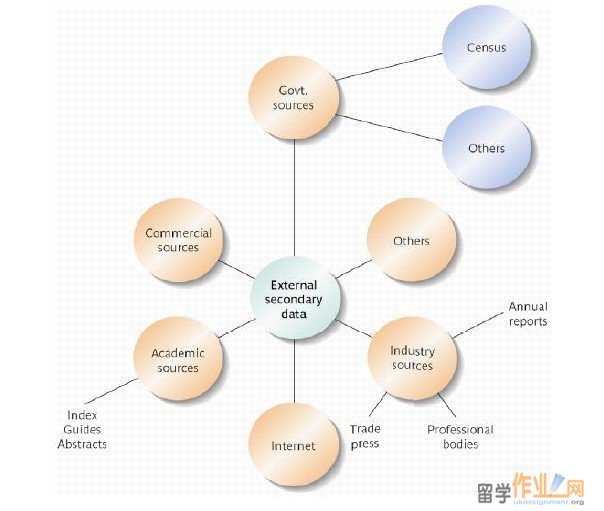
External secondary data are available in the
form of directories, databases,
government / industry reports and
syndicated services (both on and offline)Freedom of Information
n More “internal” secondary data has become
available by Freedom of Information laws
n Public authorities must make information
available through a publication scheme - a
document that lists all the different types of
information routinely made available
n This means the NHS, the Police, publicly owned
companies, schools, universities and
government, both central and localAppraising Secondary Sources
Factors to Be Considered:
n Who has collected the data (did they have adequate resources)?
n Why was the data collected (how interests of the agency matches with
ours)?
n How was the data collected (what is the quality of data on-hand)?
n What data was collected (geographic and demographic limitations)?
n When was the data collected (how old/obsolete is the data)?
n Is there consistency?
(Aaker, Kumar & Day 2007)
Applications of Secondary Data
n Demand Estimation
n Monitoring the Environment
n Segmentation and Targeting
n Developing a Business Intelligence
System
(Aaker, Kumar & Day 2007)
Applications of Secondary Data
(Contd.)
n Census data
n Standard Industrial
Classification (SIC)
n Trade association data
n Experts and authorities
n Press releases
n Legislation and laws
n Industry news
n Business and
practitioner literature,
such as magazines
Demand Estimation Monitoring the Environment
(Aaker, Kumar & Day 2007)
Applications of Secondary Data
(Contd.)
n PRIZM
n CLUSTER PLUS
n ACORN
n DMI
n NAICS
n TIGER
n Competitor’s annual
reports
n Press releases
Segmentation and Targeting Developing a Business
Intelligence System
(Aaker, Kumar & Day 2007)
5. Search Plan Features
n Three approaches are likely:
¨visits to general and specialist libraries
¨contacting human experts
¨carrying out computer searches
Features of a plan#p#分页标题#e#
You must decide:
• time and cost
• number of sources
• age of sources,
• format of data
• methodology used
Allocate time to:
n identify sources
n locate sources
n secure access to
documents
n regular progress
reports to the client
Continuous needs
n Set up permanent
information requests
n Set up intricate delivery
formats
n Set up on-going news alerts
Two needs require different plans.
One-off needs
n Set up temporary information
requests
n Use human experts
n Plan to stop receiving
information
Planning
The Internet
Desk research will start
with the Internet so
the user must be
familiar with
¨directories
¨metasearch
engines
¨ search agents
Computer-Retrievable Methods
n Scope of information
available
n Speed of information
access and retrieval
n Commercially available
search procedures provide
considerable flexibility and
efficiency
n Rely solely on the accuracy
of the abstract author
n Depend on the journal and
article selection policy of the
database producer
n Might miss important
information, or retrieve a lot
of irrelevant data if
searching by “keyword”
Advantages Limitations
(Aaker, Kumar & Day 2007)
Assessing the value
n To assess the reliability of information look at the
source and the context
n Use the MR Mix to ascertain the original
Purpose, Population used, the Procedure
followed and the reason for original Publication.
(see example)
n For any sector look for the top companies,
important trade press titles, trade associations
and trade directoriesEvaluation of source and context
n Measure reliability and trustworthiness
¨Reliability
n Completely reliable; usually reliable; fairly reliable;
not usually reliable; unreliable; cannot judge
reliability (marks from five though to zero)
¨Trustworthiness
英国指导coursework-secondary research-指导英国coursework样本n Confirmed elsewhere; probably true possibly true;
doubtful; improbable; cannot determine the truth
(marks from five though to zero)
¨Add marks together, if 6 or more is likely to be
usable. If 5 or less, then use with caution
(Aaker, Kumar & Day 2007)