 13128872179
  2419493733
  Telegram:ukassignment021
 1.1 Introduction介绍
在英国,90%的女工遭受过性骚扰。这不是一个不切实际和夸大的数据。这确实反映了女职工处于危险境地。同时,欧盟指出,总体而言,西欧男性的每小时收入比女性高出约16%,全球近70%的女性员工没有休产假。这些都说明女职工的权利得不到有效的保护。在这种情况下,劳动法可能是一个很好的办法,以拯救妇女从一个糟糕的工作情况。本文将从女工在工作场所的状况和西欧有关女性性骚扰的劳动法两个方面对女性性骚扰进行详细的阐释。此外,它还将描述男女工人之间的工资不平等。此外,西欧产假的现象、影响和法律都将得到准确的借鉴。许多人都知道妇女在工作中处于不利地位。她们面临着性骚扰、工资不平等、带薪产假等问题。因此,通过建立女性员工的劳动法规来保护女性员工是至关重要的。本研究的主要目的是说明有关女工的劳动法在西欧女职工中所起的重要作用。
In the UK, 90 percent of female workers had suffered sexual harassment (Bajema & Timmerman 1998). This is not an unrealistic and exaggerated data. It does reflect that women employees are in dangerous situation. Meanwhile, European Union (2014) pointed out that men earn about 16 Percent more per hour than women in western Europe in general and almost 70% women workers did not have maternity leave in the world (Fallona, Mazarb & Swissc, 2017). These all show that women employees’ right are not effectively protected. Under these circumstances, labor law may be a good way to save woman from a bad job situation.The essay will explain in detail the women sexual harassment from the phenomenon of women employees’ condition in work place and the labor law about female sexual harassment in western Europe. In addition, it will also describe the wage inequality between male and female workers. Furthermore, the phenomenon, the effects and the law about maternity leave in western Europe all will be referred precisely. It is known to many that women are at a disadvantage at work. They face the issues about sexual harassment, wage inequality, paid maternity leave. Therefore, it is vital to protect female employees by building workforce regulation for them. The main purpose of this research paper is to show that labor laws about female workers play an important role in female staff in western Europe.
1.2.1 The situation of female employees suffering from sexual harassment in the workplace女员工在工作场所遭受性骚扰的情况
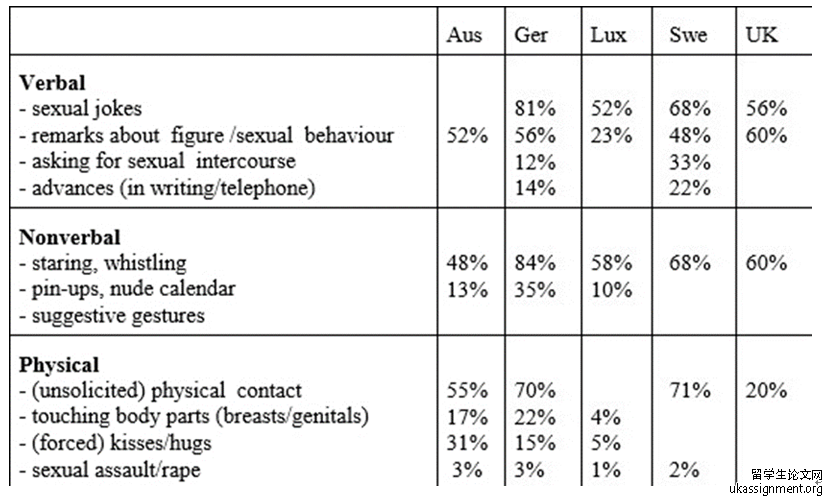
Figure1. The type and proportion of female employees suffering from sexual harassment (Cela, A 2015)遭受性骚扰的女性员工的类型和比例
图1以五个欧洲国家为例,将性骚扰分为三种主要类型。提到奥地利、德国、卢森堡、瑞士和联合王国。言语性骚扰包括性笑话、关于身材的评论、要求性交和性侵犯。非语言性骚扰包括凝视、吹口哨、打手势和暗示性手势。身体性骚扰是最严重的流氓行为,包括主动身体接触、触摸身体部位、强行亲吻或拥抱以及性侵犯。相比之下,奥地利、德国、瑞士和英国关于性骚扰言论的比例都在55%左右,卢森堡只有23%的低点。奥地利、卢森堡、瑞士和英国在凝视和吹口哨方面的比例几乎相似,在48%到68%之间,但在德国达到了84%。在德国和瑞士,身体接触的比例接近70%,而且性骚扰的发生率显然很高。尽管性侵犯率只有1%-3%,但在欧洲,超过一半的人遭受过语言和非语言性骚扰。在卢森堡和英国,口头性骚扰和非语言性骚扰的比例都在50%以上,这意味着西欧的工作场所骚扰非常严重。
Figure 1 used five European countries as examples and divided sexual harassment into three main types. Austria, Germany, Luxembourg, Switzerland and the United Kingdom are mentioned. Verbal sexual harassment contains sexual jokes, remarks about figure, asking for sexual intercourse and advances. The nonverbal sexual harassment includes staring, whistling, pin-ups and suggestive gestures. Physical sexual harassment is the most serious hooliganism, including unsolicited physical contact, touching body parts, forced kisses or hugs and sexual assault. Compare with the verbal sexual harassment rate of remarks about figure in Austria, Germany, Switzerland and the United Kingdom were around 55%, Luxembourg only had a low point of 23%. Austria, Luxembourg, Switzerland and the United Kingdom have nearly similar percentages between 48% and 68% about staring and whistling, but it reached 84% in Germany. In Germany and Switzerland, the percentage of physical contact was almost 70%, and it is obviously a high rate about sexual harassment. Although sexual assault rate only 1%-3%, more than half of people had suffered verbal and nonverbal sexual harassment in Europe. In Luxembourg and the United Kingdom, the percentage of Verbal sexual harassment and nonverbal sexual harassment are more than 50%, which means that workplace harassment in western Europe is very serious.
In western Europe, about 66% female employees have admitted that they had been harassed by their superiors (Timmerman et al. 1998). Cela (2015) explain that sexual harassment in the workplace includes one-time harassment and multiple sexual harassment. Women are more likely to be harassed. If the offender is the manager of a female victim, the offender may use their right to threaten them by controlling the performance evaluation and work incentives of the female staff.
In France, the 1992 general principles of criminal law clearly stipulate that sexual harassment is an immoral behavior including threat, impose restrictions and pressure (Cela 2015). Law on modernization of society orientation and the abuse of power relations pointed out that the victim can directly call the perpetrator of sexual harassment in court correction in. Under the labor code, the harasser may stay in prison for one year and may be fined 3750 Euros, Cela (2015) described.
1.3 Workforce regulation on gender wage gap
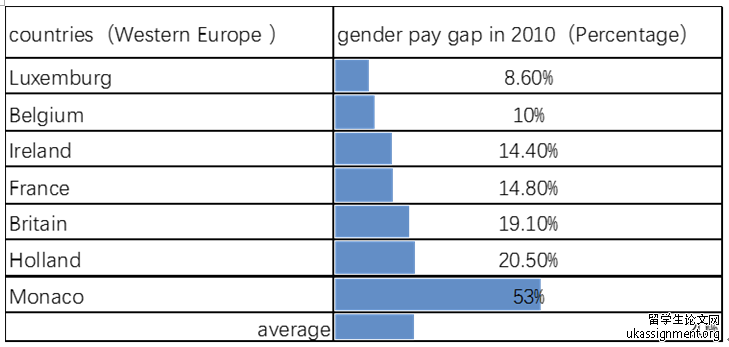
Figure 2. The percentage of gender pay gap in western Europe in 2010 (European Union 2014)
Figure 2 shows the percentage of the gender wage gap in western Europe in 2010. There are seven countries, including Luxembourg, Belgium, Ireland, France, Britain, Holland and Monaco. Luxembourg's gender wage gap was the smallest in several countries, and its percentage was only 8.6% in 2010. Nevertheless, the wage gap between men and women reached 53% In Monaco in 2010. In the rest of the country, the gender wage gap was between 10% and 20.5%. The average percentage of gender wage gap in western Europe was about 20%. According to this table, gender wage differentials exist in all Western European countries, and Monaco faced the most serious wage differentials in western Europe in 2010. The severe imbalance in the proportion of men and women in Monaco may be the cause of this problem.
1.5 Conclusion
To sum up, in western Europe, the situation of the female sexual harassment in workplace is not optimistic. In addition, the gender wage gap is also great. Furthermore, many female workers do not have paid maternity leave and some women employees lose their job during pregnancy. However, almost all the western European countries are trying to solve this problem by establishing workforce regulation. There is no doubt that labor law can prevent female sexual harassment during working to some extent, reduce the wage gap between male and female, and force employers to offer maternity leave and paid maternity leave to staff who is pregnant. In this case, although the law does not completely solve these problems, it is absolutely useful for female workers. These issues have been clearly defined in the labor law in most Western European countries. As a result, defining female sexual harassment in workplace, gender wage gap and maternity leave specifically and formulating the corresponding punishment for different situations may have a positive effect on these problems.
Reference
Bajema, CW & Timmerman, MC 1998, Sexual harassment in the workplace in the European Union,viewed on 25th April 2017,
<http://www.un.org/womenwatch/osagi/pdf/shworkpl.pdf>
Cela, A 2015, Sexual Harassment at Work: A European Experience, viewed on 25th April 2017,
<http://iipccl.org/wp-content/uploads/2015/03/Ajbals-80-91.pdf>
Convention on the elimination of all forms of discrimination against women 1979, Convention on the elimination of all forms of discrimination against women, viewed on 25th April 2017,
<http://www.un.org/womenwatch/daw/cedaw/text/econvention.htm>
Employment Protection Act 1975, Employment Protection Act, viewed on 25th April 2017,
<http://www.legislation.gov.uk/ukpga/1975/71/pdfs/ukpga_19750071_en.pdf>
Frazer, A 2008, ‘reconceiving labour law: the labour market regulation project’, Macquarie Law Journal (2008), Vol. 8, pp21-44
García-Izquierdo, LA, Ramos-Villagrasa, JP & Castaño, MA 2015, e-Recruitment, gender discrimination, and organizational results of listed companies on the Spanish Stock Exchange, viewed on 25th April 2017,
<http://www.sciencedirect.com/science/article/pii/S1576596215000419>
Monthly Labor Review 1920, ‘Bureau of Labor Statistics’, U.S. Department of Labor, Vol. 10, No. 2, pp. 235-246