 13128872179
  2419493733
  Telegram:ukassignment021
 Table of Contents
CHAPTER ONE: INTRODUCTION 4
1.1Introduction 4
1.2 Background to the study 5
1.2.1 An overview to the education system in Tanzania 5
1.2.2 Management of primary education in Tanzania 5
1.4 Statement of problem 7
1.5 Objectives of the study 8
1.6 Research questions 8
1.7 Significance of the study 9
1.8 Limitations of the study 10
1.9 Delimitation/scope of the study 10
CHAPTER TWO: 11
THEORETICAL FRAMEWORK: EMPOWERMENT THEORY 11
2.1Introduction 11
2.2 Theoretical framework of the study 12
2.3 Other Theoretical perspectives (competing theories) 12
2.3.1 The voluntary theory of participation 12
2.3.2 The communitarian theory of participation 13
2.3.3The attitude theory 13
2.3.4The Public choice theory (Buchanan and Gordon, 1962) 14
2.4 Empowerment theory: A review of literature 14
2.4.1 The roots of empowerment 15
2.4.2 Meaning of empowerment 16
2.5 Linking the The Essay is provided by UK Assignment http://www.ukassignment.org
Arnstein’s ladder of citizen participation to the concept of empowerment 18
2.6 Operational sing empowerment 20
2.7The World Bank’s model 21
2.7.1Access to information 21
2.7.2 Inclusion/ participation 22
2.7.3Accountability 23
2.7.4 Local organizational capacity 23
2.8 The Resources- Agency- Outcomes model 24
2.8.1 Resources 25
2.8.2 Agency 26
2.8.3 Achievements 26
CHAPTER 3: DECENTRALIZATION AS A STRATEGY OF ENHANCING CITIZEN POWER 27
3.1 Introduction 27
3.2 Different conceptual orientations 28
3.3 Public sector decentralisation 29
3.4 The ‘continuum’ of decentralisation 30
3. 5 Decentralisation policy in Tanzania 34
3.6 What can decentralisation contribute to the service delivery systems? 36
3.7 Educational decentralization in Tanzania 37
3.7.1Policy framework 38
3.8 Trends in the development of primary education in Tanzania 40
3.8.1 The period before Arusha Declaration (1961-1967) 40
3.8.2 The Arusha Declaration era (1967-1986) 41
3.8.3 The liberalization era (1986-to date) 43
3.9 Analytical framework of the study 43
3.9.1 Dependent variable 44
3.9.2 Independent variables 45
References 47
CHAPTER ONE: INTRODUCTION
1.1Introduction
This chapter serves as ‘a foundation chapter’, as it covers the key aspects (research problem, objectives and questions) from which the other chapters proceed. The chapter starts with an overview of the education system in Tanzania so as to establish the position of the study. That is, to put it clear as to what type of school committee the study was confined. After the overview, it proceeds to highlighting the Background to the study, Statement of the problem, Research objectives, and Research questions. The chapter The Essay is provided by UK Assignment http://www.ukassignment.org
culminates by outlining the Rationale, Limitations and Scope of the study. #p#分页标题#e#
1.2 Background to the study
1.2.1 An overview to the education system in Tanzania
Tanzania’s education system takes the pattern of 2-7-4-2-3+. That is, two years of pre-primary education, seven years of primary education, four years of certificate of secondary education( ordinary level), two years of advanced certificate of secondary education and a minimum of three years of university education (United Republic of Tanzania, 1995).
The pre-primary education is provided for children aged five to six years. Usually, there is no formal examination which promotes pre-primary children to primary schools. Instead, pre-primary education is formalised and integrated into the formal primary school system. Primary schooling in Tanzania is universal and compulsory for all children from the age of seven. The primary school cycle begins with standard one (STD I) on entry, and ends with standard seven (STD VII) in the final year. At the end of standard seven, pupils sit for the National Primary School Leaving Examination (PSLE). This examination acts as a selection examination for entry to secondary education (Form One). A Primary School Leaving Certificate (PSLC) is awarded to all children who complete standard seven (United Republic of Tanzania, 2006).
At the end of Form four, students sit for the Certificate of Secondary Education Examination (CSEE) which upon successful completion, a national certificate is awarded. Candidates who satisfy set performance criteria are selected for the Advanced Certificate of Secondary Education (ACSE). It starts at Form Five and culminates at Form Six where students sit for the Advanced Certificate of Secondary Education Examination (ACSEE). Upon successful completion, they are awarded an advanced national certificate of secondary education. Students who meet set University admission criteria are admitted for a university education that lasts for three or more years depending on the field of study.
1.2.2 Management of primary education in Tanzania
The management of primary education in Tanzania had for a long time been centrally done through the ministry of education. With this top-down control approach, things were centrally managed through the district and regional education officers. The procurement of school supplies for example, was mostly planned and implemented at the ministerial level. The centrally procured school supplies were then distributed to individual schools countrywide by the District Education Officers (DEOs). The mode of distribution to individual schools was through ‘door-delivery’ if funds were available to cover transport costs (Mushi, 2006). It was usual to see pupils carrying school supplies such as exercise books, text books, boxes of chalk and other items from the district offices to their respective schools because the district education office had no funds to cover transportation costs. With this bureaucratic system, there were lot of delays in distribution of the school supplies to their respective destinations, pupils missing classes to ferry school materials from the district headquarters and so on. In addition, the exclusion of people at the grassroots made them feel that they were not part of the development programmes. In other words, it resulted in lack of ‘ownership’ and commitment because the plans were imposed to the people rather than being developed from them through participatory planning. The government was seen as the only actor responsible to ‘bring’ education, health care services, water and other essential services to the citizens as ‘recipients’ and not as ‘participants’/ actors in the process. This consequently led to excessive workload and financial burden to the government. Yet, the availability and quality of the essential social services to the public persistently deteriorated as the time went by due to the amplified burden that the government had to shoulder. It is due to the deterioration of service provision sectors that drove the governments of the developing countries in the 1980s to embark on efforts to transform their governance processes into more participatory and inclusive forms as an attempt to increase resource availability and promote ownership among citizens at the grassroots level.#p#分页标题#e#
By examining just the aspecThe Essay is provided by UK Assignment http://www.ukassignment.org
t of procurement and supply of school materials among many others, we realize that the approach to management and administration of education was highly centralized and bureaucratic. We also see the extent to which schools were practically left with little choice and flexibility in regard to their local needs/preferences. This was happening while the government was implementing the decentralization policy that was formulated in 1972. The decentralization programme was meant to give authority to the local governments to manage and administer social services such as health care and education. Therefore as a result of the decentralization programme, the management of primary education was brought down to the local authorities. The motive behind was to involve people at the grassroots level in decision making on the issues concerned with the education of their children in their localities. However, this approach did not bring about enough control powers to the schools and the people at the local level as things were still centrally controlled at the district level.
In 2000, the government of Tanzania undertook an overall Education Sector Review Programme, with the major focus centred on primary education. This was followed by the launching of the Primary Education Development Programme (PEDP) in 2002, aimed at improving education quality, expanding school access, and increasing school completion at the primary level. This involved measures to increase resource availability and improve resource allocation and utilization; to improve educational inputs; and to strengthen institutional arrangements for effective primary education delivery by particularly empowering the stakeholders at the grassroots (United Republic of Tanzania, 2001). However, while there is high consensus on the fact that citizen empowerment in the management of social services in particular, education has a significant potential for enhancing accountability and local participation in public sector service delivery, it is not quite clear about the degree to which it contributes to improved service delivery or performance at the grassroots level for that matter.
1.4 Statement of problem
With the recent reforms in Tanzania, the primary school committees have been strengthened to manage and oversee the day to day activities as well as planning and implementing various development activities for their respective schools. Basically, the reforms are meant to mainstream the local communities into the management of education that had for many years been centralised. Empowerment of school committees seeks to enhance local ownership, democracy, inclusiveness, accountability. Each school committee represents citizens at the local level in deciding and implementing different activities at their respective school. However, there have been some challenges with regard to the functioning of school committees. It is not quite clear about the extent to which the school committees have been empowered. Yet, interference and arbitrary use of powers against school committees and teachers by some political leaders is a clear sign of inadequacy of the powers conferred to the grassroots levels. For example in February this year, the then Bukoba District Commissioner in the north-western part of the country caned some teachers for ‘failing to execute their duties in accordance with their job descriptions’ (TBC[ Tanzania Broadcasting Corporation], February13, 2009). This implies that although the primary school committees in the country have been conferred powers to make decisions on matters related to supervision of routine and development activities in particular schools at the local levels, there is no practical demonstration of citizen empowerment at the local level. It is not clear as to how this empowerment has affected the performance of school committees. In addition, there has still been some problems in as far as resource mobilization and control in some schools. This situation signals some problems in the functioning of the school management systems at the grassroots level. It is on these grounds that I decided to conduct this study to explore the functioning of the school committees, particularly, their empowerment and how this affects their performance.#p#分页标题#e#
1.5 Objectives of the study
The study intended to explore the factors affecting performance of the primary school management committees in managing education at the grassroots level. More specifically, the study aimed at accomplishing the following objectives:-
To examine the procedural requirements for members’ selection, composition and service tenure of the school committees;
To explore the extent to which school committees are informed of their roles, and the mechanisms through which information exchange between the school committees and the指导留学作业提供指导Essay,指导Assignment,请联系QQ:949925041 stakeholders(local authorities, parents, teachers and others )
To assess the competences of school committee members in terms of the necessary basic skills for sound planning and implementation of school development projects at the local level; and
To assess the willingness of individual school committee members to commit their energies and time towards promotion of education at their localities;
To examine the extent to which school committees have autonomy to make decisions and implement them in their local contexts.
1.6 Research questions
The study attempted to answer one major question: “What are the factors affecting performance of school committees in Mvomero District Council and Morogoro Municipality”? More precisely, the concern of the study was to answer the following research questions:-
What procedures are followed in the actual practice of selecting the school committee members? Is there any stipulation in regard to composition and tenure of service of school committee members? How do all these affect the committees’ performance?
How do school committees receive information and provide feedback to stakeholders? How often are there contacts? What kind of contacts: Formal? Informal? What do the stakeholders say about the adequacy of the information flow mechanisms? Do the members of the community have the opportunity to question the committee’s day to day operations?
What are the actual profiles of the school committee members? What are their levels of education? What about skills/experience possessed? What is the gap between the highest and lowest education qualification possessed? Do these have any effect to the performance of the committee? In what ways?
What is the level of commitment of individual members to work as representatives of the community in decision making at the school? Are they satisfied? What motivates them to become members of the school committee? How does this influence their performance?
What is the role of school committees when it comes to decision making and implementation at the local level? Are they given autonomy? What are the boundaries of this autonomy? How does it affect the performance of the school committees?
1.7 Significance of the study
The rationale of the study rests on the fact that the Education sector in Tanzania has undergone fundamental transformations as a result of the major administrative, economic and political reforms that have taken place in the country in the last decade. not much has been done to#p#分页标题#e#
a means to expose some strengths and weaknesses of school management committees as the means to empower citizens at the local level in the management of education and hence, providing some bases of argument for or against the effectiveness of the school management committees in the country;
a reference material to other scholars who wish to conduct similar studies in this area of and in turn, contributing to knowledge advancement and solving related problems pertaining to the citizen empowerment strategies in Tanzania and the developing countries at large.
1.8 Limitations of the study
It is important that I point out some limitations that I faced during the fieldwork and how I attempted to address them to make the study a success. One of the challenges I faced was language, where the interviews for parents, school committees and local leaders were prepared and administered and recorded in Swahili language; and later on, the data were transcribed and in English.
1.9 Delimitation/scope of the study
The study focused on the factors affecting performance of the primary school committees, particularly in Mvomero District Council and Morogoro Municipality in Tanzania. Although performance of these committees can be assessed and compared in different ways, the study was confined the study to examining the performance of the school committees in terms of how they execute their functions. I drew the boundaries to ensure easy operationalisation. In addition, some indirect indicators such as performance指导留学作业提供指导Essay,指导Assignment,请联系QQ:949925041 of pupils and discipline may be influenced by factors other than the performance school committees. Such factors may include among others, the availability and quality of teachers, suitability of the teaching-learning environment and motivation of teachers and pupils. Therefore, attributing good or poor performance of the pupils to effectiveness or ineffectiveness of the school committees may not be scientifically consistent. It is therefore on these grounds I decided to stay within those boundaries.
CHAPTER TWO:
THEORETICAL FRAMEWORK: EMPOWERMENT THEORY
2.1Introduction
This chapter provides the theoretical framework and review relevant literature to the study which sought to examine the empowerment of the primary school governance structures (the school committees) and how this influences their performance at the local level in Tanzania. The chapter ultimately depicts the position of the study within the wide context of existing literature. Three main parts are highlighted in the chapter namely, Review of related literature, Citizen Empowerment in the Tanzanian context and Operationalisation of empowerment.
In the introductory part, the main concern of the essay and theoretical framework of the study are highlighted. Literature has been reviewed in the broad and narrow perspectives of empowerment and participation.#p#分页标题#e#
2.2 Theoretical framework of the study
The study utilized the theory of empowerment to examine the whole concept of citizen participation in the management of primary schools at the local level through the school committees. My intention was to examine the empowerment of school committees in Morogoro Municipal Council and Mvomero District Council and how it affects their performance in terms of accomplishmentof the roles assigned to them. The theoretical perspectives by the World Bank (2002), Kabeer (2001) and Cohen and Bailey (1997) have been utilized as the basis analysis in this study.
2.3 Other Theoretical perspectives (competing theories)
Various theoretical approaches can be used to explain the performance of school governance structures in the context of citizen power at the local level. Some of the competing/rival theories include the Voluntary theory of participation particularly under the ‘Civic voluntarism model’ by Moyster et.al, 1992; the Communitarian theory of participation (Parry et. al, 1992); and the Attitude theory (Azjen and Fishbein, 1980; Kerlinger, 1973 & Green, 1954). The Public choice theory (Buchanan and Gordon, 1962) in the economic perspective can also be used to explain the performance of school committees under the devolved/ citizen power system.
2.3.1 The voluntary theory of participation
This is one of the theories of participation that could be used in this study. Utilizing the civic voluntarism model, Parry and Moyster et. al. (1992) identify resources such as money, time, education, and others, motivations and mobilization as the three most important classes of participation. They argue that individuals with high socio-economic status and enough time available are likely to participate more than the individuals with less time. Conversely, performance (outcome)指导留学作业提供指导Essay,指导Assignment,请联系QQ:949925041 of development interventions/projects under the devolved system can be explained in terms of the ‘intensity of the resources’ and ‘motivation’ of the actors at the grassroots level.
2.3.2 The communitarian theory of participation
The Communitarian theory of participation (Parry, et.al.1992) could also be applied in explaining performance of school committees in Tanzania under the participatory system. The communitarian theory of participation suggests that the motive of participation is a concern for the community of which a person is a part. In the view of this theory, where people are highly integrated into the local community, and where they identify strongly with it, participation would be greater. This is on the basis of the fact that often people have a better understanding of their local needs and problems, and recognize that these needs are often shared with their neighbours. Fusheini (2005) argues that when people perceive their interdependence with others, they seek to act to maintain their communal bond. “Schools depend on communities for legitimacy as they adapt to their environments while communities need schools for knowledge and skills acquisition” (Fusheini, 2005: 30). In this theoretical orientation therefore, the performance of a particular school committee can be explained on the basis of the strength of the ‘communal bond’ between the community and the school committee. In this perspective, the performance of the school committee increases with the increased strength of the bond.#p#分页标题#e#
2.3.3The attitude theory
This could be another theory to explain the dependent variable (the performance of the school committees). The attitude theory as discussed by Azjen and Fishbein (1980), Kerlinger (1973) and Green (1954) concerns the feelings of individuals towards an issue or object.
An attitude can be explained as “a predisposition to behave in a certain way” (Chapman et.al, 2002), often operationalised it as the likelihood that people’s expression of positive or negative regard toward an object, issue or event predicts the direction and intensity of their consequent behaviour towards it. The prominence of the attitude of a particular person towards an issue is largely a function of the extent that the individual has thought about the issue. Therefore, in attitude measurement, when people are asked about their attitude toward an issue with which they have little familiarity, their responses tend to lack dimensionality and vice versa. In this theoretical perspective, local community members’ /school committee members’ attitudes towards their schools are said to be a factor in determining the extent and nature of their participation in the education decisions that rest at the local/ school level and in explaining their performance in the implementation of the school development projects.
2.3.4The Public choice theory (Buchanan and Gordon, 1962)
Economists like James Buchanan and Gordon Tullock can also offer a different theoretical perspective for explaining the performance of school governance structures at the local level. To them, citizens are utility maximisers (rational decision makers). Individual citizens are assumed to be motivated by the wants or goals that put across their preferences. This forces them to act within specific constraints and on the basis of the information they have about the conditions under which they are acting. Rational choice theorists insist that individuals must anticipate the outcomes of alternative courses of action and calculate that which will be best for them. Rational individuals go for the alternative that is likely to give them the greatest satisfaction (Heath 1976: 3; Carling 1992: 27). In this theoretical perspective, the intensity of citizens’ participation in activities such as voting and others depends on the calculated benefits they expect out of those endeavours. If they feel that the benefits are not worth the cost of participation, they often tend ignore. In such a situation, performance of the projects will be poor. Analogously, the performance of school committees can be explained in terms of the calculated costs and benefits by the committee members.
2.4 Empowerment theory: A review of literature
Is empowerment a new concept? Probably this might be one of the fundamental questions one might ask. However, the question might not have a straight answer. There is a tendency of considering empowerment as a new concept, partly because of the importance currently attached to it on the agenda for development than it was ever before. In addition, the inclination of some scholars with regard to how they write about empowerment makes it appear as a new concept. As Wilkinson puts it, “...many accounts write as if empowerment is entirely a product of the times and do not see it in a historical context” (Wilkinson, 1998:44). In spite of the emphasis that is currently accorded to the importance of promoting empowerment in the planning and implementation of development interventions, it should not be regarded as a new concept. It is a concept that has been there for quite many years. #p#分页标题#e#
The concept of empowerment became more popular in the 1990s as an attempt to replace the concept of “participation”, which gradually lost its popularity since the 1980s due to its lack of authenticity. Unauthentic participation is a situation where people could “participate” in a project without having the power to decide on the critical issues related to the project (Gergis, 1999:3). Therefore, Empowerment attempts to foster meaningful or authentic participation, where decisions are made by people who have to bear the consequences of the same (McArdle, 1989). The implication here is that “it is not the achievement of goals, as much as the process of deciding that is important” (Gergis, 1999: 6). This is to say, empowerment goes a step further than participation because in the latter is wider in scope, encompassing both the weak and strong forms of participation. People can participate in a given process or activity while they do not actually have the power to make critical decisions pertaining to the activity or process they are involved in. Empowerment is concerned with the strong forms of participation, trying to see into it that people are fully involved at every stage of development intervention; namely, identification of need, identification of options/strategies, decision making/choice of action, mobilization of resources and action itself (Onyx and Benton, 1995).
However, empowerment and participation are very much linked. In a sense, the two concepts in development discourse are inseparable. That is, empowering people means promoting opportunities for their participation. On the other hand, for participation to be meaningful, people must be empowered to enable them contribute fully in the development process (Sidorenko, 2006). Empowerment and participation of citizens can be exercised in the economic, social, or political spheres; at the individual, family, community, national and global levels. Clearly, people are empowered through participation in decision making.
2.4.1 The roots of empowerment
Some scholars argue that empowerment theory is a pedigree of Paulo Freire’s educational theory, but that might not suffice. Freire’s critical pedagogy theory (Freire, 1970) has been explained as an attempt towards “empowering the oppressed by entering into the experience of oppression and assisting the oppressed in transforming oppressors through reflection and action.” (Demmitt and Oldenski, 1999: 234). The theory contributed to the transformation of the way educators viewed the poor and marginalized. Building on the work of Freire, empowerment can be analyzed in three levels: the personal (Zimmerman, 1995), the community or organizational (Peterson et al., 2002), and the socio-political (Moreau, 1990).
In the perspective of work organizations, the concept of empowerment has also been associated with popular management movements of the times such as HRM[ Human Resource Management] and TQM[ Total Quality Management] of the 1980s as an attempt to address the chronic problems of Taylorism and bureaucracy which dominated the workplaces (Wilkinson, 1998). Although the scientific management theory by F.W. Taylor[ Taylor is respected as ‘the father of scientific management’. Under his management system, factories are managed through scientific methods rather than by use of the empirical ‘rule of thumb’ so widely prevalent in the days of the late nineteenth century when F. W. Taylor devised his system and published ‘Scientific Management’ in 1911. ] was very successful in terms of increasing productivity,指导留学作业提供指导Essay,指导Assignment,请联系QQ:949925041 workers’ dissatisfaction was immense as reflected in high labour turnover, absenteeism and conflict. It is the work of Elton Mayo[ Elton Mayo conducted the popular Hawthorne experiments (1927 -1932) where he found that work satisfaction is enhanced, to a large extent, by the informal social relationships between workers in a group and upon the social relationships between workers and their bosses. The effects of the group should never be underestimated.#p#分页标题#e#
] and the Human relations school that started to advocate on involvement of workers in organization decision making for promoting business success and employees’ motivation (Rose, 1978).
From the analysis above, it can be concluded that the concept of empowerment is a result of contributions from various disciplines, making it a multidisciplinary concept that no single discipline can claim to ‘own’ it.
2.4.2 Meaning of empowerment
Empowerment takes different meanings across different socio- economic, cultural and political contexts, usually translated according to local value and belief systems (Bailey, 1992). If we explore all local terms associated with empowerment around the world, we will come up with a number of conceptions of empowerment relating to economic, social, political and cultural interpretations. Despite the diversities in the contextual viewpoints, there are some basic commonalities in the way various scholars understand empowerment.
The World Bank defines empowerment as the expansion of assets and capabilities of poor people to participate in, negotiate with, influence, control, and hold accountable the institutions that affect their lives (World Bank, 2002). This is an institutional approach to empowerment of men and women through removal of formal and informal institutional barriers that prevent them from taking action to improve their wellbeing both individually and collectively. It is a transformational process through which individuals and groups are enabled to take greater control of their lives and the environment. Empowerment envisages enabling individuals to pursue their goals successfully through positive integration at the micro (individual) and macro (community) levels. Empowerment is not a one-time event. Rather, it is a continuous process that happens over time. It has also more intrinsic than extrinsic value; though its instrumental values cannot be taken for granted (Rappaport, 1981). In other words, one should not wait for others to empower them. Empowerment comes from oneself and others only support the person’s empowerment. Rappaport thus views empowerment as a construct that links individual strengths and competencies, natural helping systems, and proactive behaviours to social policy and change.
According to Kabeer (2001: 19), “empowerment refers to the expansion of people’s ability to make strategic life choices in a context where this ability was denied to them”. In Kabeer’s framework, empowerment is analysed under three major dimensions that define the individual’s capacity to exercise strategic life choices namely; access to resources, agency and outcomes.
UNDP (2004) defines empowerment as “the process of transforming existing power relations and of gaining greater control over the sources of power” (UNDP[ United Nations Development Programme], 2004:12). This definition takes the human development approach, which views empowerment as an attempt to create an environment where people can develop their full potentials, making them creative in improving their lives according to their needs and interests and enabling them to participate actively in the development process.#p#分页标题#e#
Other writers explore empowerment at different levels: personal (psychological), implying a sense of self confidence and capacity; relational, implying ability to negotiate and influence relationship and decisions; and collective (Rowlands, 1997), which implies collective action to improve the quality of life in the community and to the connections among community organizations. However, organizational and community empowerment are not simply a “collection of empowered本站提供指导Essay,指导Assignment,请联系QQ:949925041 individuals” (Perkins and Zimmerman, 1995: 571).
2.5 Linking the Arnstein’s ladder of citizen participation to the concept of empowerment
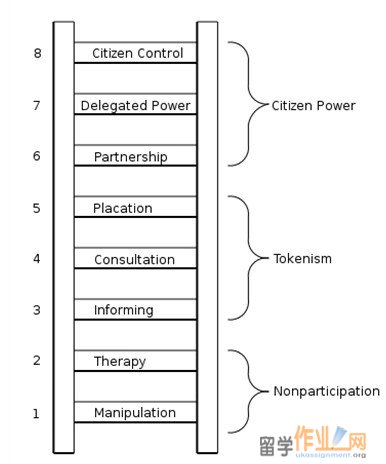
Arnstein (1969) constructed a model (the ladder of citizen participation) to explain the concept of participation. Her ladder of citizen participation was divided into eight rungs, ranging from non-participation (therapy and manipulation) to tokenism (informing, consultation, and placation) to citizen power (partnership, delegated power, and citizen control) as depicted in figure1. According to Arntein’s conception, Participation is not an absolute. Rather, it occurs on a continuum from lesser to greater participation. In this view, different scales of community participation exist. Through this ladder of citizen participation, empowerment can be explained as the highest form of citizen participation (rugs 6, 7, and 8). When potential beneficiaries can also make key development decisions, participation becomes a self-initiated action and meaningful. This is what Arnstein refers to as ‘having the real power needed to affect the outcome of the process’ (Arnstein, 1969: 216).
Participation encompasses both weak and strong forms of citizens’ power with regard to decision making/control over their development. As illustrated in the typology of eight levels of citizen participation, each rung in the ladder denotes the degree of citizens’ power in decision making. With the first two rungs which Arnstein calls manipulation and therapy, there is no authentic participation but rather, the power holders use the participation theory to legitimate their domination over the citizens’ power over decision making. This is what Bray terms as “the empty ritual of participation” (Bray, 1999:10). Basically, the two bottom rungs constitute the weakest form of citizen participation, which in practical terms may be regarded as ‘non-participation’. Under the ‘illusion’ of participation, citizens can be manipulated to form advisory committees or boards to serve their interests, while in practice, they perform ‘a mere rubber stamp role’ as they cannot influence the decision making process. Citizen participation of this type (in my opinion) is meant by the power holders to enhance public relations and to impress the international community especially, the donors. #p#分页标题#e#
Rungs 3, 4 and 5 (Informing, Consultation and Placation respectively) constitute the second level of citizen power which Arnstein calls "tokenism". At this level citizens have the opportunity to hear and to have a voice by being informed and consulted, but they lack the power to assure that their views will be taken seriously by the power holders. With this form of participation, there is no follow-through, no power, and hence no possibility of changing the status quo. Although rung 5 (Placation) is sometimes considered a more genuine approach to participation, yet citizens are not conferred full power to decide. In this view therefore, it can simply be considered as “a higher level tokenism”. This form of participation has been seen in the School Governing Bodies (SGBs) in South Africa, which seem to be there simply as the means to contain parental discontent and mobilize additional resources for running the schools. Parents’ participation in particular, depends significantly on what they are "allowed" to do by principals (Lewis and Naidoo, 2004:106), and it is restricted to ‘token involvement’ in fund-raising and other support activities.
The three upper rungs of the ladder (rugs 6, 7, 8) are levels of citizen power with increasing degrees of decision making. Citizens can enter into a Partnership that enables them to negotiate and engage in power sharing with traditional power holders. The two topmost rungs (7 and 8) involve Delegated Power and Citizen Control respectively. At these levels, citizens have strong power to make decisions. Arnstein’s ladder analogy was applied and further developed by various authors. Weidemann and Femers (1993) used it to classify the public rights and analysis of decisions needed for hazardous waste management. According to their analysis, public participation increases with the level of access to the information as well as the rights that citizens have in the decision making process. This is what empowerment consists in. The conception of empowerment by the IFAD[ International Fund for Agricultural Development] encompasses both access to resources and the capacity to participate in decisions that affect the least privileged (Moore, 1995)
The critique to the eight-rung ladder designed by Arnstein is that it is an over- simplification of reality. Taking the concept of participation as a linear process of eight levels that can be presented in a ladder metaphor is unrealistic. There is no clear-cut of where exactly each level in the ladder begins and end because social science phenomena are not the same as those of the natural science. However, like any other model, it helps to facilitate understanding of the fact that there are different forms of citizen participation. Knowing these gradations makes it possible to distinguish between meaningful/genuine citizen participation and non-participation.
Taking into consideration that empowerment is a multileveled, multifaceted and context-based concept (Schulz et. al, 1995); can we really have a common understanding about empowerment? In other words, is there a model/framework that can be claimed to be a panacea to all contexts? Certainly, it is difficult to have one. Let us take an example of a situation where we want to empower poor women to enable them to own and dispose land, and another situation where we want to empower local communities to take charge of managing their local primary school.#p#分页标题#e#
Although it is not possible to have a single model for empowerment, experience shows that certain elements are almost always present in successful empowerment efforts regardless to the differences in the contexts of empowerment interventions. It is from this view; the World Bank (2002) attempted to identify some key elements that at most tend to feature in most of the successful projects. The bank comes up with four fundamental elements of empowerment that must underlie institutional reform. The elements include: Access to information, Inclusion / participation, Accountability and Local organizational capacity.
Information is power. Well informed citizens are better equipped to take advantage of opportunities, access services, exercise their rights, negotiate effectively, and hold state and non-state actors accountable. Releasing information about the performance of institutions, future plans and many other issues of interest enhances transparency in the government, public service, and the private sector. Regulations about rights to information and freedom of the press promote informed citizen action. In this view they should be easily available by every citizen. Unrestricted two-way information flow from government to citizens, and from citizens to government is critical to responsible, responsive and accountable governance. The basic assumption here is that access to information promote stakeholders’ knowledge, competences and initiatives; making them more effective in their performance. The more the information they have, the higher is their self-confidence and initiative to make decisions and the higher is their performance.#p#分页标题#e#
Citizen participation should be meaningful. A meaningful participation is the one that results in change of the status quo. Experience shows that poor people do not participate in activities when they know their participation will make no difference to products being offered or decisions made because there are no mechanisms for holding providers accountable. An empowering approach to participation should therefore treat poor people as co-producers, with authority and control over decisions and resources devolved to the lowest level. Depending on the situation, participation may be direct (by individual citizens), representational (through representatives from membership-based groups and associations or committees.
Opportunities for all citizens to participate in decision-making are critical to ensure that the use of limited public resources builds on local knowledge and priorities and brings about commitment to change. In order to ensure inclusion and informed participation, it is important to ensure that the institutional rules create room for people to debate on various issues, participate in local and national priority-setting and in the delivery of basic services.
2.7.3Accountability
Accountability encompasses the obligations of political authorities, parties and representatives to explain their intentions and conduct to their constituencies and to voters at large and the responsibility of government agencies to fulfil their administrative and social commitments to citizens by presenting transparent periodic reports of their work for public scrutiny and discussion. Citizen action can strengthen political and administrative accountability mechanisms and put up demands for better governance and transparency.
A variety of mechanisms exist to ensure greater accountability to citizens for public actions and outcomes. Access to information by citizens builds pressure for improved governance and accountability in areas such as setting priorities for national expenditure, enhancing access to quality education, ensuring that roads once financed actually get built, or seeing to it that medicines are actually delivered and available in clinics. Access to laws and impartial justice is also critical to protect the rights of poor people and pro-poor coalitions and to enable them demand accountability, whether from their governments or from private sector institutions. Citizen action can reinforce political and administrative accountability mechanisms and build pressurise on improved governance and transparency. In Tanzania, it was found that local participation in school affairs particularly financing and management through the Community Education Fund (CEF) inculcated local accountability of schools to the local communities (United Republic of Tanzania, 2003).#p#分页标题#e#
2.7.4 Local organizational capacity
Local organizational capacity refers to the ability of people to work together, organize and mobilize resources to solve problems of common interest. Often outside the reach of formal systems, poor people turn to each other for support and strength to solve their everyday problems. Poor people's organizations are often informal, as in the case of a group of women who lend each other money or rice. They may also be formal, with or without legal registration, as in the case of farmers' groups or neighbourhood groups. The assumption here is that organized communities are more likely to have their voices heard and their demands met than unorganized communities. It is only when groups connect with each other across communities and form networks or associations (federations) that they begin to influence government decision-making and gain collective bargaining power.
Kabeer[ Researcher and women empowerment analyst from the Institute of Development Studies in Sussex, United Kingdom] views empowerment from the perspective of ‘power’. She argues that one of the approaches through which power can be conceptualized is in terms of “the ability to make choices” (Kabeer, 2001:18). Analogously, disempowerment can be conceptualized in terms of ‘choice denial’. In this view, denying people the opportunity to make their own choices amounts to disempowerment. Empowerment is thus an attempt to enhance poor people’s freedom of choice and action by removing formal and informal institutional barriers[ Formal institutions include: state, markets, civil society and international agencies whereas the informal ones include: norms of social exclusion, exploitative relations and corruption.] that inhibit them from taking action towards improving their wellbeing both本站提供指导Essay,指导Assignment,请联系QQ:949925041 individually and collectively (World Bank, 2002). By carefully examining the logic of Kabeer’s argument, I consider empowerment and disempowerment as coexisting constructs, and that whenever there are empowerment efforts, there must have been a perceived state of disempowerment that necessitated launching of the empowerment interventions.
‘Resources’ constitute the first dimension of power in this model. Resources in this respect are conceptualised in a broader perspective, encompassing the conventional economic resources such as land, equipment, finance and working capital as well as human/social dimensions nourishes one’s ability to exercise choice (Kabeer, 2001). ‘The human resources’ are within the individual, and they include their individual knowledge, skills, creativity, imagination and the like. Human resources do not end up there. They also constitute claims, commitments and expectations inherent in the relationships, networks and contacts that take place in the day to day operations and long term activities in various areas of life. Having the resources is one thing. The question now comes: ‘How the resources are distributed to the people’? This brings in the institutional arrangements and processes to govern resource distribution. Access to resources is governed by rules, norms and practices that are embedded in various institutional domains (family norms, employer- employee relationships, patron- client relationships, informal wage agreements and public sector entitlements, just to mention a few. It is through the rules and norms some actors (household heads, heads of tribes, heads of organizations and others) are given power over others in shaping the modalities of allocation and exchange within particular institutional contexts in respect of the positions they hold. The way through which people gain access to resources is crucial. Lack of access to resources is equally the same as lack of resources themselves when it comes to analysis of empowerment. Empowerment in this respect means improvement of access to and acquisition of resources.
2.8.2 Agency
This is the ability to define one’s goals and pursue them. It includes observable (activities) and unobservable actions like the meaning, motivation, motives of individuals in their activities. Agency is also termed as ‘power within the individual.’ Its measurement can be done through ‘individual decision making’. It encompasses a wide range of purposive actions such as bargaining, negotiation, deception, manipulation and some more intangible cognitive dimensions such as reflection and analysis. Agency has both positive and negative meanings in relation to power (Sen, 1999). In the positive connotation, it takes the form of ‘power to’. This is the people’s capacity to define their life choices and pursue their own goals even in the presence of external opposition. The negative meaning of power implies ‘power over’, i.e. the ability of an actor or group of actors to over-ride the agency of others. This can be through violence, coercion and threat. There are instances where power can also operate in the absence explicit agency where the norms governing social behaviour tend to ensure reproduction of certain outcomes without any apparent exercise of agency (Lukes, 1974). #p#分页标题#e#
2.8.3 Achievements
The combination of resources and agency results into capabilities, which imply the potential that people have for living the lives they wish, and of achieving valued ways of ‘being and doing’ which according to Sen (1990, 1999.a) imply achievements realized by different individuals. Kabeer’s third dimension of power is constituted from the ‘achievements’ or failures as the case may be, though she cautions that there are some cases where failures to achieve valued ways of ‘being and doing’ can be a result of laziness, incompetence or other individual-specific reasons, so the issue of power becomes irrelevant.
This chapter discusses decentralization as a strategy of citizen empowerment. Decentralization has been discussed both in theory and practice, linking it to the concept of citizen empowerment. The chapter presents a review of literature on public sector decentralisation in general, comparing different perspectives. The chapter narrows down to discussing the decentralisation policy in Tanzania and in particular, the educational decentralisation policy framework. The chapter captures some important trends in the development of the primary education management in the country since her independence in 1961. The relevance of reviewing decentralisation theory and practice to this study rests on the fact that citizen empowerment depends on the relationship between the state institutions. That is the decision making machinery from the centre to the periphery. Decentralisation was opted for by many countries of the world (Tanzania being one of them) as a means本站提供指导Essay,指导Assignment,请联系QQ:949925041 through which citizen power can be enhanced at the local level. In a nutshell, the essence of decentralisation rests on promotion of democracy, efficiency, accountability and responsiveness to local needs. Therefore the concept of decentralisation has been utilised in this study because of its inseparability from the concept of citizen empowerment. The latter has been used as a means to realise the former. Decentralisation focuses on community participation, collaboration, equitable distribution of resources and local decision making (autonomy) which are key variables of citizen empowerment.
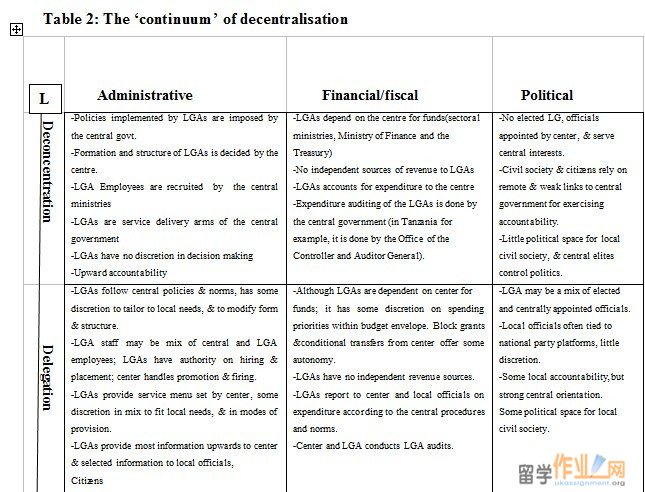
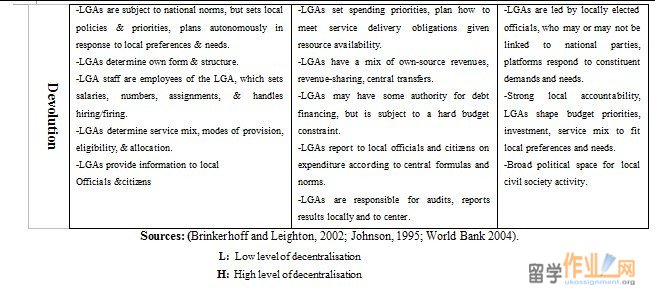
Decentralisation has been viewed differently by various people. While most of the views are unanimous on the idea that decentralisation concerns the ‘shifting of decision making authority and power from a central point (such as the central government) to its local units (local government), there are some differences with regard to the scope and specificity (Dyer and Rose, 2005). For instance, while some definitions focus on the partial transfer of authority and power from the centre to the periphery (deconcentration and delegation), others suggest total shifting of authority and power from the central point to its respective local units (devolution).#p#分页标题#e#
My concern in this part is to examine decentralisation of the public sector because it has always been the most important pillar in supporting national development, not only in the developing countries but also in the developed ones. Public service provision in most of the countries is at large provided by the state. Even where these services are provided by private bodies, non-governmental organisations and/or civil societies, the state remains the principal regulatory body. This part of the chapter therefore attempts to analyse decentralisation in the public sector, focusing on the main types, forms and features, implicating them to citizen power and control at the local levels. Along this line of argument, decentralisation within the public sector can in essence be discussed under three main types namely; political, fiscal and administrative decentralisation.#p#分页标题#e#
Decentralisation is broad. It may take different forms ranging from the lowest to the highest degrees of power shift from the centre to the periphery. The levels of power-shift that constitute the ‘continuum’ of decentralisation are: de-concentration, delegation and devolution (Brinkerhoff and Azfar, 2006).
As part of the devolved system, privatization means that the government gives up responsibility for certain functions and transfer them to certain private enterprises (Rondinelli and Cheema, 1983, Lauglo, 1995) for the purpose of enhancing better performance.
3. 5 Decentralisation policy in Tanzania
Tanzania like many countries of the world has embarked on decentralisation programmes in order to establish local governments which can deliver quality services to the people in a participative, effective and transparent way, and promote direct accountability of the local authorities to the people. However, despite these negative impacts noted, the benefits of decentralized governance are more explicit and cannot be taken for granted In as far as citizen empowerment is concerned; Tanzania considers decentralization as an appropriate approach to encourage local initiatives in the development process in the rural and urban areas, as it gives the people more power in decision making. By involving people at the local level in the planning, implementation, and evaluation process, a partnership is established between the government and the people in development interventions and hence, making the people feel as important stakeholders in the process. Since Independence, the government has adopted several decentralization measures geared towards promoting rural and urban development (Kabagire, 2006). These include:
Restructuring of the Ministry of Economic Affairs and Development Planning in 1968/1969 whereby Regional Economic Secretaries were posted, to selected regions to coordinate the planning process.
Ministerial reform in 1969 which came up with changes in the cooperatives and the creation of the Ministry of Regional Administration and Rural Development.
Decentralization of government administration in July 1972 to give power to the people with regard to decision making concerning their development. A decentralized structure with clearly defined development responsibilities, coordination, and direction of the rural development work of all Ministries and Regions was established. A direct link between local organizations and the centre was established through the Regional Development Director (RDD). The decentralized structure consisted of the Regional Development Committees, the District Development councils and Ward Development Committee.
Enactment of the Villages and Ujamaa Villages, Act of 1975 which further strengthened decentralization by establishing village councils that were charged with participatory development by the people at the local level, which was meant to realize the following four key objectives: First, to ensure that local development is effectively managed by organs that are closer to the people; second, to ensure full involvement of the people in the development process; third, to ensure that development is effectively planned and controlled; and fourth, to ensure that rural and urban development are centrally coordinated for efficiency and effectiveness.#p#分页标题#e#
Looking at the positive side, Gurgur and Shah (2002) argue that decentralization minimises corruption that tends to crop up with bureaucratic and centralized authority. With decentralisation, there is accountability and transparency which in turn improves service delivery. In another study, King and Ozler (1998) observed that decentralized management of schools led to improvement in achievement scores in Nicaragua. Decentralization improves citizen’s access to social services and ensures that social services provided to citizens are responsive to the local contexts. This argument is confirmed by Faguet (2001), who found that decentralization in Bolivia helped improve consistency of public services with local preferences and quality and access of social services. This is also in concurrence with Dyer and Rose (2005) who claim that the quality of education can be improved by providing for decision making powers at the points of their implementation. In this way, it is possible to suit the local context in terms of expertise and experience. However the question remains to be ‘what form of decentralisation is adopted?’ in other words, how much powers are conferred to the local level in as far as decision making is concerned? Is it just symbolic or is intended to ensure meaningful citizen power? If the latter is true, there should be devolution of powers to the local levels and not merely deconcentration or delegation.
First, the perceived complexity of managing the modern education from one central point led to the governments’ acceptance of decentralised educational management systems. The essence of that shift lies on efficiency improvement. Second, the concern to ensure that each individual student has access to the particular as opposed to an aggregated mix of resources to cater for the needs and interests of that particular student. Third, some study findings in the developing countries with regard to school effectiveness and improvement have been insisting on decentralisation as a vehicle for success. Fourth, the fact that increased autonomy of the teachers and some bureaucrats at the local level increases ownership and commitment makes decentralisation an ideal strategy for educational management. Fifth, popular demand for more freedom and power of choice in terms of the schools they would prefer according to their perceived qualities by the general public; and sixth, the fact that the education sector should follow the reforms that were instituted in the other similar sectors which were earlier presumed to be solely the concern of the central government. Now with regard to how these are applicable to the developing world, much can be debated especially on the basis of the varying contexts of the developing and the developed countries.
Educational decentralization in Tanzania aims to promote community participation in decision-making and cost sharing to ensure sustained effective provision of education and proper use and maintenance of school resources, and to reinforce planning and management capabilities at all levels of the school system. Educational decentralization in Tanzania is embedded in the general government decentralization framework (United Republic of Tanzania, 2007b.), called the Local Government Reform Program (LGRP). Various service provision responsibilities have been transferred to districts and Local Government Authorities (LGAs) through the Prime Minister’s Office-Regional Administration and Local Government (PMO-RALG). #p#分页标题#e#
Primary education is the most important responsibility of local governments in Tanzania. Half of all their funds is spent on this activity (although most funds are provided by the central government), and two-thirds of all local government employees are teachers. Local government decision-making is vested in the district council. A majority of its members are directly elected at the ward level. At the lower level, the village council has much the same functions as the district council. At the school level the school committee (in which parents are represented) has the overall responsibility of overseeing the running of the school.
3.7.1Policy framework
Education decentralisation in Tanzania is implemented under a framework of various interlinked policies. This section, therefore, is intended to provide the policy context under which education decentralisation takes place.
Tanzania Development Vision 2025 was formulated in 1995, aiming at realising total elimination of poverty in the country by the year 2025. Tanzania’s Vision 2025 recognises education as a strategic agent for transformation of the citizens’ mindsets, and for the creation of a well educated nation adequately equipped with the knowledge needed to solve the development challenges which face the local communities and the nation as a whole. In this view, Vision 2025 stresses on restructuring and transforming education qualitatively, with a focus on promoting creativity and problem solving. Along the same line, Tanzania Development Vision 2025 devolves a greater role to the local actors to own and drive the process of their own development. The document puts it clear that the local people know their problems than any body from outside. In that view therefore, they can decide what they need to prioritise, what is possible to achieve and how it can effectively be achieved under the prevailing local conditions.
The Education and Training Policy (ETP) was formulated in 1995 as a product of the liberalisation policy which started in Tanzania in 1986. The liberalisation policy came to effect in the country after the signing of an agreement with both International Monetary Fund (IMF) and the World Bank (WB) (Mrutu, 2007). As such, the thrust of the policy initiatives is privatisation, and changing of the role of state into facilitation as opposed to state ownership in the provision of services.
3.7.1.3 Education Sector Development Programme (1996)
The Education Sector Development Programme (ESDP) was developed in 1996. This followed the development of the Education and Training Policy that was formulated in 1995. ESDP is a sector wide approach that was initiated to facilitate achievement of the government’s long term human development and poverty eradication targets and to redress the problem of fragmented interventions under the project modality of development assistance. The essence of the sector wide approach is collaboration by the key stakeholders, using pooled human, financial and material resources for planning, implementing, monitoring and evaluation. This approach established new relations which promote partnership, co-ordination, and ownership amongst all groups of people with a vested interest in education (United Republic of Tanzania, 2001).
Reform of the local government system was initiated in 1996 seeking to move towards a Vision for Local Government in Tanzania. This vision was subsequently summarised in the Local Government Reform Agenda, and, in October 1998, was endorsed by the Government in its Policy Paper on Local Government Reform (Mmari, 2005). The programme implementation of the LGRP began on 1st January, 2000. The LGRP is a primary mechanism for the decentralisation and devolution of power to local levels, a main feature in the delivery of education at the primary level. The Local Government Reform Programme (LGLP) is a vehicle through which the government promotes and derives the decentralisation processes (Mmari, 2005).
The Primary Education Sub-sector sector in Tanzania has undergone significant developments from 1961 when the then Tanganyika got her independence, all geared towards empowering the citizens. The trends can be traced along three major socio-economic development periods which the country has gone through namely, the period before Arusha Declaration(1961-1967); the Arusha Declaration era (1967-1986) and the period after Arusha Declaration /liberalization era (from 1986 to date).
3.8.1 The period before Arusha Declaration (1961-1967)
Right after independence in 1961, the main concern of Tanzania mainland (the then Tanganyika) was to create an environment for socio-economic development. During the first Development Plan, the government identified ignorance as one of the major three hindrances of social and economic development in the country– others included disease and poverty (Nyerere, 1967). The then new government was determined to eradicate ignorance through investment in human capital, which with time would produce a healthy and well-educated population that is crucially needed for social and economic development. Towards this endeavour, Tanzania has undertaken a number of policy and development initiatives in the education sector with a focus to improve quality and access to school education. Investing on human capital was considered the main tenet towards creating a healthy and well educated population for social and economic development (Kamuzora, 2002). The new government enacted the Education Act of 1962 that repealed the colonial legislation (the Education Ordinance) that was in force since 1927 (Mamdani, 1996; United Republic of Tanzania, 1995). As a means to ownership by the local communities, the newThe Assignment is provided by UK Assignment http://www.ukassignment.org legislation intended to make Local Authorities and communities responsible for the construction of primary schools; provision of primary education; streamlined the curriculum; examination and financing of education (United Republic of Tanzania, 1995).
3.8.2 The Arusha Declaration era (1967-1986)
It was during this period various attempts to reform education received a special impetus. Following the Arusha Declaration on 5th February 1967, President Nyerere launched the Education for Self-Reliance (ESR) policy to guide the planning and practice of education as a step towards putting the Arusha Declaration into effect, as the ESR policy was a programmatic follow-up of the objectives spelt in that Declaration.
The Structural Adjustment Programmes (SAPs) of the 1980s had adverse outcomes to the primary education in Tanzania. In their study, Lema et al (2004) observed that in 1999, out of every 100 children of primary school age, 56 were enrolled in schools; of 56 enrolled in schools; only 38 completed primary school. Of the 38 who completed primary school, only 6 proceeded to secondary schools. Moreover, there were significant differences in school enrolment according to location reflectingThe Assignment is provided by UK Assignment http://www.ukassignment.org regional, district, ethnic and urban-rural differences (Mukandala and Peter, 2004).
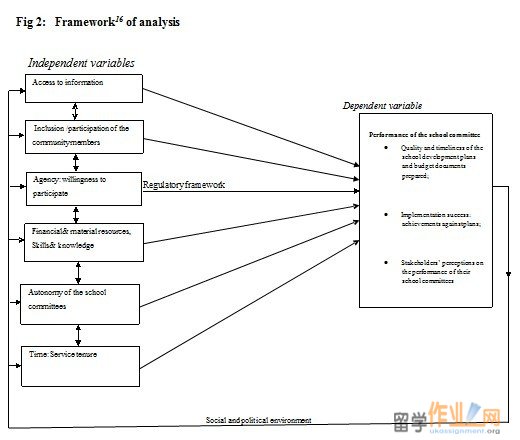
In the light of the reviewed literature, I developed a framework to guide my study. The basic assumption of the study is that: ‘Performance of the school committees depends on the extent to which they are empowered’. The study by Aedo (1998) shows the Chilean schools that have been conferred significant power to make decisions perform better than those under centralized control. In the same line, King and Ozler (2000) noted a positive effect of decentralization on parent participation in school decision-making in Nicaragua, while in on the other hand, Galiani, et. al .(2005) argue that decentralization of public schooling in Argentina in the early 1990’s helped to improve the quality of education in terms of standardized test scores. However, it seems that the studies focused more on the academic performance of the schools, which is not my concern in this study. Academic performance of students is a multi-dimensional construct, that many not be attributed to the functioning of school committees alone but some other factors such as availability and quality of teachers, suitability of the teaching-learning environment, motivation of teachers and pupils and government policies. In the proposed study, I intend to examine how the empowerment dimensions affect performance of the school committees by focusing on the administrative functions of the school committees such as resource mobilization, creation of infrastructure such as classrooms, planning and budgeting and finance. The reason behind this decision is that these responsibilities are specifically vested to the school committees at the local level under the educational decentralization system (United Republic of Tanzania, 2001); and therefore can easily be measured in a more direct way.#p#分页标题#e#
3.9.1 Dependent variable
The dependent variable of the study is Performance of the school committees, and it was operationalised through the following indicators that have been established from the responsibilities of school committees as spelt in the PEDP document under the item “institutional responsibilities” (United Republic of Tanzania, 2001: 16). This will be operationalised in terms of Quality and timeliness of the school development plans and budget documents prepared; Implementation success that is, actual achievements against planned activities; financial reports prepared (timeliness and accuracy); and stakeholders’ perceptions on the performance of their school committees.
3.9.2 Independent variables
From the assumption that ‘Performance of the school committees depends on the extent to which they are empowered’, the independent variables were the empowerment dimensions/indicators namely, access to information, inclusion/participation, capabilities /competences (knowledge and skills), Agency (willingness/motivation), autonomy and time (service tenure of the committees). Each variable will be measured as follows:
This was operationalised by examining the extent to which school committee members has adequate information on their roles, the school, rules and regulations and policies and the number of meetings convened by school committees to inform parents and other stakeholders about the schools’ progress. The assumption here is that the higher the access to information by the school committees, the higher the performance (Behrman et. al, 2002).
This was operationalised by finding out the extent of community members’ participation in electing the school committee members. The representativeness of the committee in terms of gender balance and inclusion of the marginalized groups was also examined. The assumption here is that participation makes the community members feel that the committee originate from themselves. This in turn, can enhance cooperation between the committee and the community.
3.9.2.3 Capabilities: knowledge and skill potentiality of committee members
This variable was operationalised by assessing the educational qualifications, skills and competences possessed by individual school committee members; number of capacity building programs organized by the authorities responsible and attended by the school committee members; and future capacity building plans in place. The assumption here is that the higher the level of capabilities the higher the performance. As Behrman et.al (2002) argue, devolution of decision making to local and school levels make school management more accountable to the community, promote cost consciousness, efficiency and effectiveness. However, the authors are of the view that where capabilities are lacking on either sides (school management and the community, the outcome realisation is questionable.#p#分页标题#e#
This was operationalised by assessing the willingness /motivationThe Assignment is provided by UK Assignment http://www.ukassignment.org of the school committees to assume their roles and also the same was done to the local community members in terms of participation. Assumption: The higher the level of motivation the higher the performance.
This was measured in terms of the extent to which the school committees can autonomously make and implement decisions without external interference. The assumption here is that the higher the autonomy, the higher the performance. According to the study by Eskeland and Filmer (2002), there was evidence of positive correlation between performance and the autonomy of primary schools in Argentina, where more autonomous schools performed significantly higher than the less autonomous schools. The assumption under this variable is that that the higher the autonomy the higher the performance.
This was operationalised by examining the tenure of service of the school committees. The assumption is that more tenure will give the committees an opportunity to perform better because of ‘strong teamwork’.
References
Abu-Duhou (1999).School-based management. Paris: UNESCO/IIEP.
Arnstein, S. R. (1969). ‘A Ladder of Citizen Participation’. American Institute of Planners.
35 (1):216–24.
Azfar, O. and J. Livingston (2002). Federalist Disciplines or Local Capture? An Empirical Analysis of Decentralization in Uganda. IRIS: University of Maryland.
Azjen, I., Fishbein, M. (1980). Understanding Attitudes and Predicting Social Behavior. New York: Prentice Hall.
Bailey, D. (1992). ‘Using participatory research in community consortia development and evaluation: Lessons from the beginning of a story’. American sociologist. 23 (4): 71-82.
Bana, B. And S. Ngware. (2005). Reforming the Public Service: The Tanzanian Experience. In Kiragu, Kithili & Mutahaba, Gelase (Eds.), Public Service Reform in Eastern and Southern Africa: Issues and Challenges (pp198-22) Dar es Salaam: Mkuki na Nyota Publishers.
Behrman, J.R., Deolalikar, A.B and Lee-Ying Soon (2002). Conceptual issues in the role of education decentralisation in promoting effective schooling in Asian Developing Countries. Economic and Research Department: Working paper series No.22. Manila:Asian Development Bank.
Biswalo,P.M. (1985). A Study of the Impact of the Musoma Resolution on Student Personnel Services at the University of Dar -es- Salaam. Utafiti Journal. VII (2):75-81. #p#分页标题#e#
Bray, M. (1987).School clusters in the third world: Making them work. Paris: UNESCO/IIEP.
Bray, M. (2000). Community Partnerships in Education: Dimensions, Variations and Implications. Education for All 2000 Assessment, Thematic Studies.
Brinkerhoff, D. and C. Leighton (2002). “Insights for Implementers: Decentralization and Health System Reform”, Partners for Health Reform plus (PHRplus). 1: 1-11.
Brinkerhoff, D.W and O. Azfar (2006). “Decentralisation and Community Empowerment: Does Community Empowerment deepen democracy and service delivery”? Paper prepared for U.S Agency for International Development, Office of Democracy and Governance: Washington D.C.
Buchanan, J.M. and T. Gordon. (1962).The Calculus of Consent: Logical Foundations of Constitutional Democracy. Ann Arbor: University of Michigan Press.
Burpitt, W.J and W.J. Bigoness (1997). ‘Ledership and motivation among teams: The impact of empowerment’. Small Group Research. 28:414-423.
Carling, A. (1992). Social Divisions. London: Verso.
Chapman, D., Barcikowski, E., Sowah, M., Gyamera, E., and G. Woode. (2002). ‘Do communities know best? Testing a premise of educational decentralization: community members’ perceptions of their local schools in Ghana’. International Journal of Educational Development 22: 181–189.
Cheema, G.S. and D. Rondinelli (eds). (1983).Decentralisation and development: Policy implementation in developing countries. Beverly Hills: SAGE publications.
Cobb, A.K. and S. Forbes. (2002). ‘Qualitative Research: What does it have to offer to the Gerontologist?’ The Journals of Gerontology Series A: Biological Sciences and Medical Sciences 57:M197-M202. http://biomed.gerontologyjournals.org/misc/terms.shtml
Cohen,S.G. and D.E. Bailey (1997). What makes teams work: Group effectiveness research from the shop floor to the executive suite. Journal of Management. 23:239- 290.
Creswell, J.W. (2009).Research design: Quantitative, qualitative and mixed methods approaches. 3rd edition. California: SAGE Publications, Inc.
Davidson, E.(2004). ‘Quality Education for All? Insights from Case study Primary Schools in Tanzania’. Journal of the Faculty of Education University of Dar es Salaam. 24:109-125.
Demmitt, A., and T.OldenskiThe Assignment is provided by UK Assignment http://www.ukassignment.org (1999). ‘The diagnostic process from a Freirian perspective’. Journal of humanistic counselling, education and development. 37: 232-239.
Dyer, C. and P.Rose (2005). ‘Decentralisation for education development: An Introduction’. Compare. 35(2):105-113.
Eskeland, G. and D. Filmer. (2002). ‘Autonomy, Participation and Learning in Argentine Schools: Findings and their implications for Decentralization’. World Bank Policy Research Paper Series No. 2766.#p#分页标题#e#
Estache, A. and S. Sinha (1995) 'Does Decentralization Increase Spending on Public Infrastructure?’ Policy Research Working Paper 1457. Development Economics. Washington DC: World Bank.
Ewald, J. (2002). "A Matter of Choice? Cost Sharing in Education and its implications for social development and children's rights to education. A case study from Tanzania", in Melin, M. (ed.) Education - a Way out of Poverty?, New Education Division Documents No.12, Sida: Stockholm
Faguet, J.P. (2001). ‘Does Decentralization Increase Responsiveness to Local Needs? Evidence from Bolivia’. Policy Research Working Paper No.2516. Washington DC: World Bank.
Freire, P. (1970). Pedagogy of the oppressed. New York: Herder and Herder.
Fundi, S.S. (2002). ‘Community Participation in Education: An Insight to Major Challenges Facing Participatory System in Primary Education in Tanzania’. M.Phil. thesis (unpublished): Department of Administration and Organization Theory, University of Bergen.
Fusheini, A. (2005). ‘Community participation in school development: Understanding participation in Basic schools performance’. M.Phil thesis (unpublished): Department of Administration and Organization Theory, University of Bergen.
Galabawa, J. (2001). ‘Development and Issues Regarding Universal Primary Education (UPE) in Tanzania’. Paper presented at ADEA Biennial Meeting held in Arusha, Tanzania, 7-11 October.
Galiani, S., Paul G., and S. Ernesto. (2005) ‘School Decentralization: Helping the Good Get Better, but Leaving the Poor Behind’. Working Paper. Universidad de San Andres. http://www.utdt.edu/congresos/pdf-sri/eee-691.pdf
Geo-jaja, M.K.(2004). Decentralisation and privatisation of education in Africa: Which option for Nigeria? International Review of Education. 50: 307-323.
Gergis, A. (1999). “Citizen economic empowerment in Botswana: Concepts and principles”. Botswana Institute for Development Policy Analysis (BIDPA) working paper No.22. Gaborone: BIDPA.
Govinda, R. (1997). Decentralisation of educational management : Experience in South Asia. Paris: UNESCO/IIEP.
Green, B.F., 1954. Attitude measurement. In: Lindzey, G. (Ed.), Handbook of Social Psychology. 1:355–369. Cambridge, MA.
Gurgur, T. and A. Shah (2002). ‘Localization and Corruption: Panacea or Pandora’s Box?’ In Ehtisham Ahmad and Vito Tanzi (eds).Managing Fiscal Decentralization. (pp. 46–67). London and New York: Routledge Press.
Heath, A. (1976). Rational Choice and Social Exchange. Cambridge: Cambridge University Press.
Held, D. (1996). Models of Democracy, London: Policy Press.
Hill, M. and P. Hupe. (2002). Implementing Public Policy. London: SAGE Publications.#p#分页标题#e#
Hyatt, D.E. and T.M. Ruddy. (1997). An examination of the relationship between work group characteristics and performance. Personnel Psychology. 50:553- 585.
Johnson, R. (1995). “Decentralization Strategy Design: Complementary Perspectives on a Common Theme.” Washington, DC: US Agency for International Development, Implementing Policy Change Project, August.
Kabagire, A.L. (2006). ‘Towards effective delivery of public services in Africa: Delivery of public services in a devolved system of governance- The Tanzanian experience’. A paper presented at the 28th African Association for Public Administration and Management (AAPAM) annual roundtable conference on 4th-8th December 2006, Arusha, Tanzania.
Kabeer, N. (2001) “Resources, agency and achievement: Reflections on the measurement of women’s empowerment”, in A. Sisask (Ed) Discussing women’s empowerment- theory and practice: Sida studies series 3: 17-52. Stockholm: Sida.
Kamuzora, F. and T. Anna (2002). ‘A Review of Approches to Development Interventions in Tanzania. From Projects to Livelihood Approaches’. Working Paper Series, February 2002. Paper No. 3. Morogoro: Department of International Development.
Kerlinger, F.N. (1973). Foundations of Behavioral Research. New York: Holt, Rinehart and Winston.
King, E. and B. Ozler. (1998). ‘What’s Decentralization Got to Do with Learning? The Case of Nicaragua’s School Autonomy Reform.’ Washington, D.C.: The World Bank Development Research Group.
King, E. and B. Ozler (2000). ‘What’s Decentralization Got to Do with Learning? Endogenous School Quality and Student Performance in Nicaragua.’ Washington D.C.: World Bank Development Research Group.
King, G., Keohane, R. O. and S. Verba. (1994). Designing Social Inquiry: Scientific Inference in Qualitative Research. New Jersey: Princeton University Press.
Komives, K. (2001), ‘Designing pro-poor water and sewer concessions: Early lessons from Bolivia,’ Water policy. 3(1).
Kvale, S. (1996). Interviews: An introduction to qualitativeThe Assignment is provided by UK Assignment http://www.ukassignment.org research interviewing. California: SAGE Publications Incl.
Kiwara, A. D. (1994). ‘Health and Health Care in a Structurally Adjusting Tanzania.’ in Msambichaka, L. A. et al (eds). Development Strategies for Tanzania: An Agenda for the Twenty First Century. Dar es Salaam: DUP. 269-290, 270.
Lauglo, J. (1995). ‘Forms of decentralisation and their implication for education’. Comparative Education. 31(1): 5-29.
Lema, E., Mbilinyi, M. and R. Rajan. (Eds.) (2004). Nyerere on Education. Nyerere Kuhusu Elimu: Selected Essays and Speeches 1954-1998. Dar es Salaam: HakiElimu.
Lewis, S.G. and J. Naidoo. (2004). “Whose theory of participation?: School governance policy and practice in South Africa”. Current issues in comparative education: 100-112.#p#分页标题#e#
Lincoln Y.S and E.G. Guba. (1985).Naturalistic inquiry. Beverly Hills, California: SAGE Publications Incl.
Lukes, S. (1974). Power: A radical view. London: The MacMillan Press Ltd.
Macpherson, C.B. (1977). The life and times of Liberal democracy. Oxford: Oxford University Press.
Mamdani, M. (1996). Citizens and Static Subject: Contemporary Africa and the Legacy of Late Colonialism. Princeton: Princeton University.
Marshall C. and G.B. Rossman (1999).Designing Qualitative Research. 3rd ed. Thousand Oaks, California: SAGE Publications Incl.
McArdle, J. (1989). “Community development tools of trade”. Community Quarterly. 16:47-54.
Mc Ginn, N. and T. Welsh (1999). Decentralisation of education: Why, when, what and how? Paris: UNESCO/IIEP.
Mmari, D. (2005). ‘Decentralisation for Service Delivery in Tanzania’. A Paper Presented at the Conference on Building Capacity for the Education Sector in Africa (October, 12th -14th) in Oslo, Norway.
Moore, B.H. (1995). ‘In their hands: for the Rural Poor Sustainable Development means Secure Access to Land’. The popular coalition to eradicate hunger and poverty, Rome: IFAD.
Moreau, M.J. (1990). Empowerment through advocacy and consciousness-raising: Implications of a structural approach to social work. Journal of Sociology and Social Welfare, 17: 53-67.
Mrutu, R. (2007). Tanzania Experience in the Implementation of Dakar Agreement of Education For All (EFA). Master’s Thesis. Oslo: University of Oslo.
Msambichaka, L.A., Kilindo, A.A. and Mjema, C.D. (1995). Beyond structural adjustment in Tanzania. Success, failures and new perspectives. University of Dar Es Salaam: Economic Research Bureau.
Msekwa, P. (1975). Ag1zo la Utekelezaji wa Elimu ya kujitegemea.University of Dar- es- salaam calendar (1976/77 p.15). Dar- es- salaam: University of Dar -es- salaam.
Mukandala, R. and C. Peter. (2004). Local Government, Effectiveness and Humana Rights in Tanzania: The Case of Bukoba Rural and Mtwara-Mikindani Districts. Paper Presented to the International Council on Human Rights Policy Review Seminar, Geneva, 27-28 June.
Mushi, D.P. (2006). Review of experience with direct support to schools in Tanzania. Economic Research Bureau, University of Dar-es-Salaam.
Nyerere, J. (1967).Education for Self-Reliance. In Ujamaa Essays on Socialism (pp.44-76).
Dar es Salaam: Oxford University Press.
Olsen, H.B. (2007). Decentralisation and local governance (Module 1).Bern: Swiss Agency for Development Co-operation (SDC).
Onyx, J. and P. Benton. (1995). Retirement: A problematic concept for older women. Sydney: U.T.S. School of Management
Parry, G., G. Moyster, et. al. (1992). Political Participation and Democracy in Britain. Cambridge: Cambridge University Press.#p#分页标题#e#
Patton M.Q. (1990). Qualitative Research and Evaluation Methods. 2nd ed. Newbury Park, California: SAGE Publications Incl.
Perkins, D.D. and M.A. Zimmerman. (1995) ‘Empowerment, theory, research and application’. American Journal of Community Psychology. 23(5): 569- 579.
Peterson, N. A., Hamme, C.L. and P.W. Speer. (2002). ‘Cognitive empowerment of African Americans and Caucasians: Differences in understanding of power, political functioning and shaping ideology’. Journal of Black Studies. 32:336- 351.
Rappaport, J. (1981). In praise of paradox: A social policy of empowerment over prevention. American Journal of Community Psychology, 9: 1–25.
Rappaport, J. (1984). ‘Studies in empowerment: Introduction to the issue.’ Prevention in Human Services, 3: 1–7.
Ravallion, M., 1998. ‘Poverty Lines in Theory and Practice’.Papers 133, World Bank - Living Standards Measurement. In http://ideas.repec.org/p/fth/wobali/133.html
Requena, S.A. (2001).Municipal Water Services Project in Bolivia. Financing and institutional issues. Washington. World Bank.
Rondinelli, D.A. and Cheema, G.S.(1983). ‘Implementing decentralisation policies: An Introduction’. In Cheema G.S. and Rondinelli, D.A(eds).Decentralisation and development: Policy implementation in developing countries: Beverly Hills, C.A: SAGE publications.
Rose, M. (1978).Industrial behaviour. Harmondsworth: Penguin.
Rowlands, J. (1997) Questioning empowerment: Working with women in Honduras.
UK: Oxfam.
Sayed,Y. (1999). ‘Discourses of the policy of educational decentralisation in South Africa since 1994: An examination of the South African Schools Act’. Compare. 29(2):141-152.
Schulz, A.J., Israel, B.A., Zimmerman, M.A., Checkoway, B.N. (1995).Empowerment as a multi-level construct: Perceived control at the individual, organisational and community levels. Health Education Research.10 (3):307-327.
Sen, A. (1990). `Gender and Cooperative Conflicts'. In I. Tinker (Ed.). Persistent inequalities. 123- 49. Oxford University Press.
Sen, A. (1999.a) Development as Freedom. Oxford: Oxford University Press.
Sen A. (1999.b), “Democracy as a Universal Value” Journal of Democracy. (10)3: 3-17.
Sidorenko, A. (2006). ‘Empowerment and participation in policy action on ageing’. A presentation at the International Design for All Conference in Rovaniemi, Finland, 2006.
Soudien,C. and Sayed, Y.(2005). ‘Decentralisation and the construction of inclusion education policy in South Africa’. Compare. 35(2):115-125
_______ (2002). Empowerment and Poverty Reduction: A Sourcebook. Washington: PREM, World Bank.#p#分页标题#e#
_______ (1988). Community The Assignment is provided by UK Assignment http://www.ukassignment.org Management and Financing of Schools in Papua New Guinea. In: Mark Bray with Kevin Lillis (eds.), Community Financing of Education: Issues and Policy Implications in Less Developed Countries: 155–69. Oxford, Pergamon Press.
Uemura, M. (1999). “Community Participation in Education: What do we know?” HDNED, The World Bank.
UNDP. (1995). Human development report. New York: Oxford University Press.
UNDP. (2004) Nepal Human Development Report 2004: Empowerment and Poverty Reduction, Kathmandu: UNDP.
UNICEF. (2001). A reference kit on violence against women and girls in South Asia. New York: UNICEF.
United Republic of Tanzania. (1982). Local Government Authorities Act of 1982. Dar -es- Salaam: Ministry of the Local Government.
United Republic of Tanzania. (1995) Education and Training Policy. Dar- es- Salaam: Ministry of Education and Culture.
United Republic of Tanzania. (1998). Local Government Reform Programme. A Policy Paper on Local Government Reform. Dar es Salaam: Ministry of Regional Administration and Local Government.
United Republic of Tanzania. (1999). Tanzania Development Vision (2025). Dar es Salaam: Planning Commission.
United Republic of Tanzania. (2000). Poverty Reduction Strategy (PRSP). Dar es Salaam: Government Printer.
United Republic of Tanzania. (2001). Basic Education Master Plan (BEMP). Medium Term Strategic and Programme Framework 2000- 2005. Dar es Salaam: Ministry of Education and Culture.
United Republic Tanzania (2003). ‘Final Evaluation of Community Education Fund (CEF)’. Dar es Salaam: Ministry of Education and Culture.
United Republic of Tanzania(2004). Joint Review of the Primary Education Development Programme (PEDP). Final Report. Dar es Salaam: Ministry of Education and Culture.
United Republic of Tanzania (2006). Basic Education Statistics in Tanzania (BEST): National Data, 2003-2007: The Ministry of Education and Vocational Training (MoEVT).
United Republic of Tanzania (2007a). Basic Education Statistics in Tanzania (BEST): 2003-2007, National Data, June, 2007: The Ministry of Education and Vocational Training (MoEVT).
United Republic of Tanzania (2007b). Local Government Reform Programme- Embedding Decentralisation by Devolution across Government. Assessment Report for the Ministry of Education and Vocational Training. Final Report. Dar es Salaam: Prime Minister’s Office-Regional Administration and Local Government.
Weidemann, I. and S. Femers (1993). ‘Public participation in waste management decision making: Analysis and management of conflicts.’ Journal of Hazardous Materials. 333: 355-368.
West, L.A. and C.Wong. (1995). ‘Fiscal decentralization and growing regional disparities in rural China: Some evidence in the provision of social services’. Oxford Review of Economic Policy. 11(4).#p#分页标题#e#
Wilkinson, A. (1998). ‘Empowerment: Theory and practice’. Personnel review. 27 (1):40- 56.
World Bank (2004). World Development Report 2004: Making Services Work for the Poor. Washington, DC: World Bank.
Yin, R. (2003).Case study research: Design and methods.3rd edition. Thousand Oaks, California. SAGE Publications Incl.
Zimmerman,M.A. (1995). ‘Psychological Empowerment: Issues and Illustrations.’ American Journal of Community Psychology. 23(5): 581-599.