 13128872179
  2419493733
  Telegram:ukassignment021
1。模块代码:MBSP 0354
2。模块标题完全:国际金融
3。学分:15
4。等级:M
5。联系信息:爱德华•科尔
房间M 334
电话分机- 5430
6。模块目的:理解金融问题具体到跨国公司,连同相关理论;理解技术来管理这些问题。
知识和理解:有一个知识和理解:1。国际金融系统;2。测量和管理的汇率风险;3。资本预算的问题具体到跨国公司;4。公司结构的设计的跨国组织为了保证其有效的财务管理和最大化股东的财富,包括相关的税收和现金管理问题;5。目前在国际金融问题::1。利用国际金融理论分析跨国公司面临的风险;2。制定策略,识别和管理国际金融风险;3。评估建议国际资本投资;4。批判评价方案设计公司结构的一支多国组织,承认现金管理、税收和法律方面的考量。
1. Module code:
MBSP 0354
2. Module Title in full:
International Finance
3. Credit points:
15
4. Level:
M
5. Contact Details:
Edward Kerr
Room M 334
Telephone extension - 5430
E mail address
6. Module aims:
understand the financial problems specific to multi-national companies, together with the associated theory;understand techniques for managing these problems.
7. Module Intended Learning outcomes:
(a). Knowledge and Understanding:
have a knowledge and understanding of:1. the international financial system;2. the measurement and management of currency risks;3. problems of capital budgeting specific to multi-national companies;4. the design of the corporate structure of multi-national organisations in order to ensure their effective financial management and the maximisation of shareholders' wealth, including associated taxation and cash management issues;5. current issues in international finance. (b). Skills and Attributes:
be able to:1. use international financial theory to analyse risks faced by multi-national corporations; 2. devise strategies for identifying and managing international financial risks; 3. assess proposals for international capital investment;4. critically evaluate proposals for the design of the corporate structure of a multi-national organisation, recognising cash management, taxation and legal considerations.
8. Module content:
This module aims to set financial management within an international context to allow students to explore the financial issues specific to multi-national corporations. It will examine the theory associated with these issues and the techniques employed by multi-national corporations in their financial management.
9. Weekly programme:
WEEK 1 - Week Commencing 05 OCT 09:
Lecture Theme: Introduction to the Module
International Monetary System - 1
Text Book Reading: Chapters 1, 3 & 8
Seminar Content: No Seminars this Week
WEEK 2 - Week Commencing 12 OCT 09:
Lecture Theme: International Monetary System - 2
Text Book Reading: Chapters 2 & 6
Seminar Content: No Seminars this Week
WEEK 3 - Week Commencing 19 OCT 09:
Lecture Theme: Theories of International Finance
Text Book Reading: Chapters 4 & 7
Seminar Content: Discussion of Topics Arising from Lecture & Text Book Readings
(See Note at End)
WEEK 4 - Week Commencing 26 OCT 09:
Lecture Theme: International Financial Markets.
Text Book Reading: Chapter 5
Chapter 16 - Sections 16.1 to 16.5
Chapter 17 - Sections 17.1 & 17.2
Seminar Content: Discussion of Topics Arising from Lecture & Text Book Readings
WEEK 5 - Week Commencing 02 NOV 09:
Lecture Theme: Devising a Foreign Exchange Management Strategy
Discussion of Assessment
Text Book Reading: Chapters 10 & 11
Chapter 32 - Sections 32.3, 32.4 & 32.5
Seminar Content: Discussion of Topics Arising from Lecture & Text Book Readings
WEEK 6 - Week Commencing 07 NOV 09:
Lecture Theme: Techniques for Exposure Management
Text Book Reading: Chapter 12 & 13
Seminar Content: Seminars this week will focus on the Multiple Choice Questions in Test Bank 1 (pages 164 to 166) and students should have attempted these questions prior to the seminars. In addition, students should have attempted Test Bank 1 (pages 161 to 164). Answers to the Multiple Choice questions are given at page 708. Answers to Test Bank 1 are given at pages 696 to 699 and problems arising from Test Bank 1 will be dealt with during the seminar.
WEEK 7 - Week Commencing 23 NOV 09:
Lecture Theme: Multi-National Capital Investment - 1
Text Book Reading: Chapters 20, 21 & 22
Seminar Content: Discussion of topics arising from Lecture & Text Book readings.
WEEK 8 - Week Commencing 30 NOV 09:
Lecture Theme: Multi-National Capital Investment - 2
Text Book Reading: Chapters 23, 24, 25 and 26
Seminar Content: Seminars this week will focus on the Multiple Choice Questions in Test Bank 2 (pages 239 to 241) and students should have attempted these questions prior to the seminars. In addition, students should have attempted Test Bank 2 (pages 237 to 239). Answers to the Multiple Choice questions are given at page 708. Answers to Test Bank 2 are given at pages 699 to 701 and problems arising from Test Bank 2 will be dealt with during the seminar.
WEEK 9 - Week Commencing 07 DEC 09:
Lecture Theme: Current Issues in International Finance - 1
Text Book Reading: Guided Reading to be Advised
Seminar Content: Seminars this week will focus on the Multiple Choice Questions in Test Bank 3 (pages 358 to 370) and students should have attempted these questions prior to the seminars. In addition, students should have attempted Test Bank 3 (pages 357 to 358). Answers to the Multiple Choice questions are given at page 708. Answers to Test Bank 3 are given at pages 701 to 703 and problems arising from Test Bank 3 will be dealt with during the seminar.
WEEK 10 - Week Commencing 14 DEC 09:
Lecture Theme: Current Issues in International Finance - 2
Text Book Reading: Guided Reading to be Advised
Seminar Content: Discussion of Topics Arising from Lecture & Text Book Readings
It will be noted that many of the Seminars include a discussion of topics arising from the Lectures and Text Book readings. In order to act as a focus for this activity, a number of specific questions are given at the end of the PowerPoint presentation for each Lecture.
10. (a) Assessment details:
Coursework/examination weight:
100% Coursework
Details of coursework assessment:
There are two pieces of Course Work:
The first is a practical exercise to allow students to assess the reliability of International Financial Theory
This will be posted on StudyNet on 02 NOV 09. The Due Date is Mon 30 NOV 09
The second is an analysis of a Case Study, which illustrates a potentially real-life scenario
This will be posted on StudyNet on Mon 30 NOV 09. The Due Date is Mon 11 JAN 10.
10 (b) Deferral/Referral Assessment
Hand in Dates
Details of the coursework assessment have been agreed to the standard as:
Monday 28 JUN 09
Details of the Refer / Defer Coursework will be posted on this StudyNet Site on 04 MAY 09
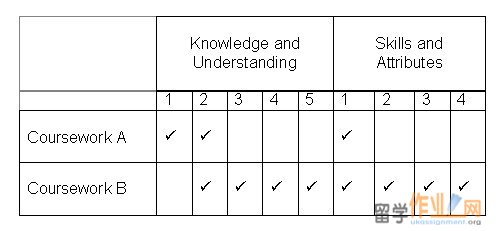
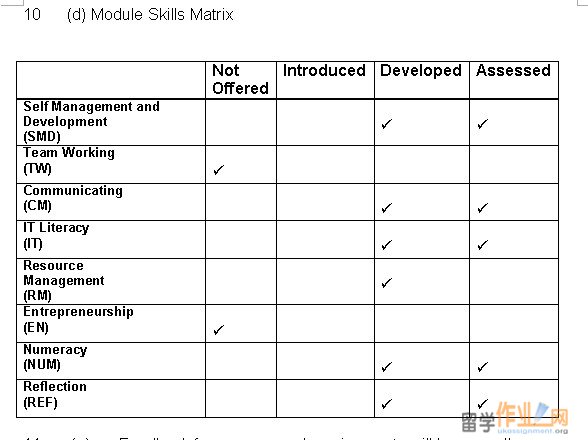
10 (c) A matrix detailing Intended Learning outcomes (pre-numbered from section 8 (a) and 8 (b) above) with the mode of assessment as follows:-
11. (a) Feedback from coursework assignments will be normally provided using the Business School Assignment Assessment Form' which will provide details of the strengths, weaknesses, grading rationale and points for improvement regarding your submitted work.
(b) UHBS reserves the right to use electronic means to identify plagiarism.
12. Grading details:
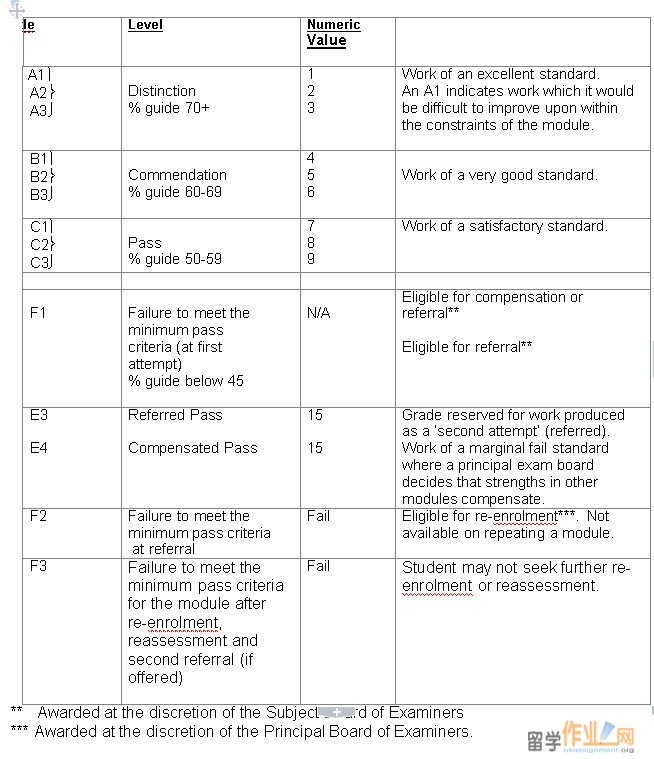
The Grading Criteria is given as Appendix A to this Module Guide.
13. (a) Module pre and co requisites (if appropriate):
None
(b) Generally the knowledge and understanding required for a direct entry Student:
Not Applicable
14. Note - All aspects of the module are potentially examinable.
The information given in this Module Guide is believed correct, but the Business School reserves the right, at its discretion, and for any reason, to make changes to the Guide without prior notice and in particular:
to make changes to syllabuses and modules for reasons including meeting technological or academic developments or employer's requirements particularly in specialists options;
not to offer options, specialisms or elective modules within a programme of study where there is insufficient student demand.
15. Expectations of the University for students on taught programmes
In order to get the best from your studies and achieve your goals, the Business School expect you:
to behave in an acceptable, respectful and considerate manner to fellow students, administrators and academic staff
to realise that being a full time student is equivalent to having a full-time job requiring at least 35 hours per week self study in preparation for workshops, seminars, lectures and assessments
to attend and participate in lectures, tutorials, workshops and other timetabled classes
to be punctual in attending classes
to turn off mobile 'phones prior to entering class
to complete and hand in all assignments by the appropriate deadline
to provide responsible feedback on your learning experience as requested
to ensure you do not breach the University Regulations with regard to cheating, plagiarism and ethical issues
to comply with any University and external regulations affecting your studies
APPENDIX A
Postgraduate Grading Criteria
HOW YOUR POSTGRADUATE WORK WILL BE ASSESSED
Module grades and calculation of awards
A Grades
Work of an excellent standard. An ‘A’ grade will count towards a Distinction on the programme as a whole. An A1 indicates work upon which it would be difficult to improve within the constraints of the module.
A grade work:
will have demonstrated excellent achievement of all the module learning outcomes
will frequently be characterised by a degree of originality
should demonstrate a thorough understanding of key concepts within the subject
will, where appropriate, be characterised by the application of theoretical concepts to empirical issues with appropriate reflection
requires that all of the elements of the question set will have been addressed
will show evidence of reading beyond that specified by the tutor/examiner, reflecting a broad literature review
will show an ability to approach reading with a critical understanding
will show evidence, where required, of an ability to evaluate contrasting viewpoints and draw conclusions
will demonstrate a degree of independence of thought, rather than relying simply on the ideas of others, perhaps as contained in the prescribed reading for the module
will demonstrate an ability to analyse and synthesise information
will always be written in a clear and concise manner, will be well constructed and the argument of the work will flow smoothly.
will include an appropriate range of references using one of the recognised protocols.
will normally be presented to a high standard.
B Grades
Work of a very good standard. A ‘B’ grade will count towards a commendation on the programme as a whole.
B Grade work :
will have demonstrated good achievement of all the module learning outcomes
will demonstrate an ability to integrate theoretical concepts with business or management practice, where appropriate
will address the key elements of the question set
will usually show evidence of reading beyond that specified by the tutor/examiner
will provide evidence of a good grasp of prescribed literature
will show evidence, where required, of an ability to evaluate contrasting viewpoints and draw conclusions
will demonstrate evidence of independent thought
will generally be written in a clear and concise manner with a good structure and a logically developed argument
will normally be well-presented
will include references using one of the recognised protocols for academic work
C Grades
Work of a satisfactory standard. A ‘C’ grade will count towards a pass in the programme as a whole.
C Grade work:
will have demonstrated achievement of all the module learning outcomes
will demonstrate attempts to integrate theory and practice, demonstrating understanding of both
will demonstrate familiarity with, and understanding of, prescribed literature
should demonstrate an understanding of the existence of alternative viewpoints, where these exist or where required by the question
may incorporate evidence of independent thought
will be generally coherent, though some weaknesses in structure or clarity may be evident
will be presented to a satisfactory standard
will include an indication of literature consulted, using the prescribed referencing protocol
F Grades
Work of insufficient quality to achieve a Pass standard. It may be eligible for referral.
F Grade work may suffer from some or all of the following defects:
will have demonstrated achievement of few of the module learning outcomes
fails to address the question set
no attempt to integrate theory and practice
little or no understanding of relevant theory and/or business and management practice
little or no reference to appropriate literature
little or no evidence of independent thought
little or no evidence that the candidate has grasped key ideas
is incoherent or has severe faults in its construction
inadequate citation of appropriate literature
makes unsubstantiated statements or assertions
is unduly descriptive and/or lacks analysis
is badly presented
is late without having gained permission through the Business School procedures
is unduly derivative of the work of others, for example, quoting or copying large tracts from published works
PLAGIARISM OR COPYING is an extremely serious offence and may incur severe penalties beyond a Fail Grade