 13128872179
  2419493733
  Telegram:ukassignment021
IMPORTANT STATEMENT
Plagiarism: the presentation of the work of another (from whatever source: book, journal, internet etc) as if it were one’s own independent work. This can be anywhere on a continuum ranging from sloppy paraphrasing to verbatim transcription without crediting sources.
You are advised to refer to the Student Handbook on matters of cheating and plagiarism as they relate to coursework, group assignments, class tests and examinations. Both cheating and plagiarism are totally unacceptable and the University maintains a strict policy against them. It is YOUR responsibility to be aware of this policy and to act accordingly.
The University requires that the following statement is included in all module documents.
“You are reminded of the University Disciplinary Procedures which refer to cheating. Except where the assessment of an assignment is group-based, the final piece of work which is submitted must be your own work. Close similarity between assignments is likely to lead to an investigation for cheating. It is not advisable to show your completed work to your colleagues or to share and exchange disks.
You must also ensure that you acknowledge all sources you have used. Work which is discovered to be the result of collusion or plagiarism will be dealt with under the University’s Disciplinary Procedures, and the penalty may involve the loss of academic credits.
If you have any doubts about the extent to which you are allowed to collaborate with your colleagues, or the conventions for acknowledging the source you have used, you should first of all consult module documentation and, if still unclear, your module tutor.”
You will be asked to confirm in writing when handing in any piece of assessed work that it is your own by completing the Coursework Submission & Record Form which should be printed from ECMS My-course on
It is the STUDENT’S responsibility to accurately complete the form and comply with its rules and guidance as described in the student handbook for this academic year.
Learning Outcomes to be Assessed:
1. Demonstrate an understanding of the properties and characteristics of digital signals and
digital signal processing systems.
2. Use mathematical modelling and simulation tools for the analysis of basic and complex digital
signal processing algorithms.
3. Apply and evaluate digital signal processing techniques for real-time signal conditioning.
4. Design and implement the digital signal processing algorithms.
Please refer to the module guide, for the full syllabus document.
Assessment Details:
This assessment is designed to help develop your understanding of digital signal processing and the use of MATLAB. Provide suitable background information, to support your answers.
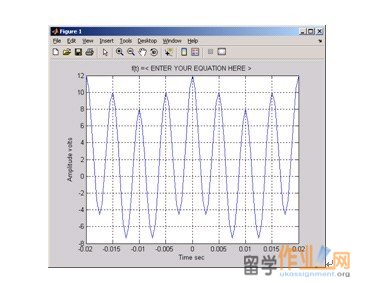
1. Given the following plot in Fig Q1. Deduce the equation for and hence verify using MATLAB.
Fig Q1 Signal Plot [`10 Marks]
2. Given the following continuous time signal:
a) Calculate the frequencies contained in the signal. Show all working and provide any background information you feel relevant.
b) Write a m-file including the subplot command to plot each frequency and Be sure to include suitable comments as part of your m-file.
c) Using a suitable sample frequency but 50 sample points, write a m-file to plot the fft of the signal x(t). Discuss any limitations of the algorithms or methods that you have employed to write your program(s).
[20 Marks]
3. Write a suitable m-file to plot the following discrete signal,
An exponential signal , is sampled at frequency of 10Hz, beginning at time t=0.
Note the sequence generated will be of differing length, so you will need to ensure that the
lengths are the same. Write a suitable m file to prove the following.
a) Plot the sampled sequence, , up to the fifth term.
b) Plot a delayed sequence by 0.2 seconds.
c) Plot the sequence a)+b)
[10 Marks]
4. Design a simple lowpass FIR filter using the sinc function and the Hamming window.
a) Write an m-file to create a signal consisting of three frequencies f1=1900Hz, f2=5100Hz and f3 = 7000Hz.
b) Stating any assumptions and showing all working out, design a lowpass filter, to recover f1. Optimize your filter coefficients using the Hamming window.
c) Using the convolution command in Matlab, convolute the signal created in Q4 (a) with the impulse response Q4 (b). Confirm that the f1 has been recovered. Design the same filter using sptool, and hence discuss any advantages and/or any http://www.ukassignment.org/dxygassignment/ disadvantages of the use of sptool in digital filter design? Explain how you would import your signal and filter coefficients to the Texas TMS320C5510 DSK.
[50 Marks]#p#分页标题#e#
5. Report structure and style [10 Marks]